How to Find Viral Content in Your Niche Before It Peaks (2026 Guide)

Most creators find a winning format the same week it saturates. Here's the dual-baseline method for catching rising formats in your niche while they still move numbers.
Most creators find a winning format the same week everyone else does — which is the week it stops working. The video that looked like a goldmine on Monday is a tired template by Friday, and the feed has already moved on. A viral content discovery tool for creators exists to close that gap: to surface a rising format while it is still rising, inside your specific niche, before the For You page fills with copies. Spotting a viral video after the fact was never the hard part. The hard part is telling a format that is about to peak from one that already has. That difference is measurable. This guide walks through exactly how to read it — the lifecycle every viral video moves through, the dual-baseline scoring that separates a real outlier from a big account's ordinary day, and a repeatable five-step routine you can run in twenty minutes a morning to find viral content before it peaks.
Table of contents
- What viral content discovery actually means
- The lifecycle of a viral video: rising, peaking, saturated
- How a dual-baseline tool works
- A 5-step workflow to find content before it peaks
- Reading the signals together
- Mistakes that keep creators chasing peaks
- Frequently Asked Questions
What viral content discovery actually means
Discovery and trending are not the same thing, and conflating them is why most research time gets wasted. Trending tells you what is already big. Discovery tells you what is about to be — the format that is over-performing right now, in a niche small enough that the wider feed has not noticed yet. The first is a popularity contest you have already lost. The second is an opening.
The catch is that raw view counts cannot tell those two states apart. Two million views on a creator with two million followers is a Tuesday. Two million views on a creator with eighty thousand followers is a format breakout — something about the structure of that video broke through a ceiling it had no business breaking. Discovery is the practice of finding the second kind on purpose, at scale, before the structure gets copied to death.
That is only possible against a baseline. The ViralVault index tracks 23,000+ videos across 7,800+ creators and rescores them daily, which means every video can be measured against two reference points at once: how the creator normally performs, and how the niche normally performs. Without that context, "discovery" is just scrolling with extra steps.
Treated this way, discovery is less about chasing virality and more about building a content swipe file for creators in your exact lane — a running shortlist of structures that are proven to travel, captured while they are still early enough to use.
The distinction worth holding onto is structures over topics. A swipe file full of subjects — money, gym, recipes — ages badly, because the subject was never what carried the video. A swipe file of structures — a reverse-order reveal, a two-second visual hook, a specific way of withholding the payoff — keeps paying out, because those beats port from one niche to the next long after the original topic cools. Collect the recipe, not the dish.
The lifecycle of a viral video: rising, peaking, saturated
Every format moves through three phases, and your job is to act in the first one. A video is rising when its performance is still accelerating: the Outlier Score climbs day over day, and saves and shares outpace likes because viewers are bookmarking it to copy or send. It is peaking when the score is high but flat, and the first wave of copies starts showing up in the feed. It is saturated when the score slides and every third video you scroll is the same template with a different face.
| Stage | What the numbers look like | What to do |
|---|---|---|
| Rising | Outlier Score climbing day over day, saves and shares outpacing likes | Make your version now |
| Peaking | Score high but flat, copies appearing in the feed | Ship today or skip it |
| Saturated | Score sliding, every third video is the same template | Move on, archive the format |
Momentum is the tell. A high score on its own is ambiguous — it could be a format on the way up or a format on the way down. The direction of the score over the last few days resolves the ambiguity. Platforms hint at this in their own data; TikTok surfaces fragments of it through search behavior, as TikTok's own newsroom has documented around Creator Search Insights. But the platform shows you topics, not the structural lifecycle of a specific format, and it shows them after they are already broad.
Two forces shorten the window. The algorithm amplifies a working format hard and fast, pulling its peak forward, and the moment it does, every creator watching the same feed starts shipping copies — which is what tips a format from peaking into saturated. The runway you have is roughly the distance between when the score starts climbing and when the copies arrive, and in fast niches that can be three or four days. Estimate it by counting how many near-identical videos already exist: a rising score with almost no copies is wide open, while a rising score sitting next to a dozen clones is a format you are already late to, no matter how good the number looks.
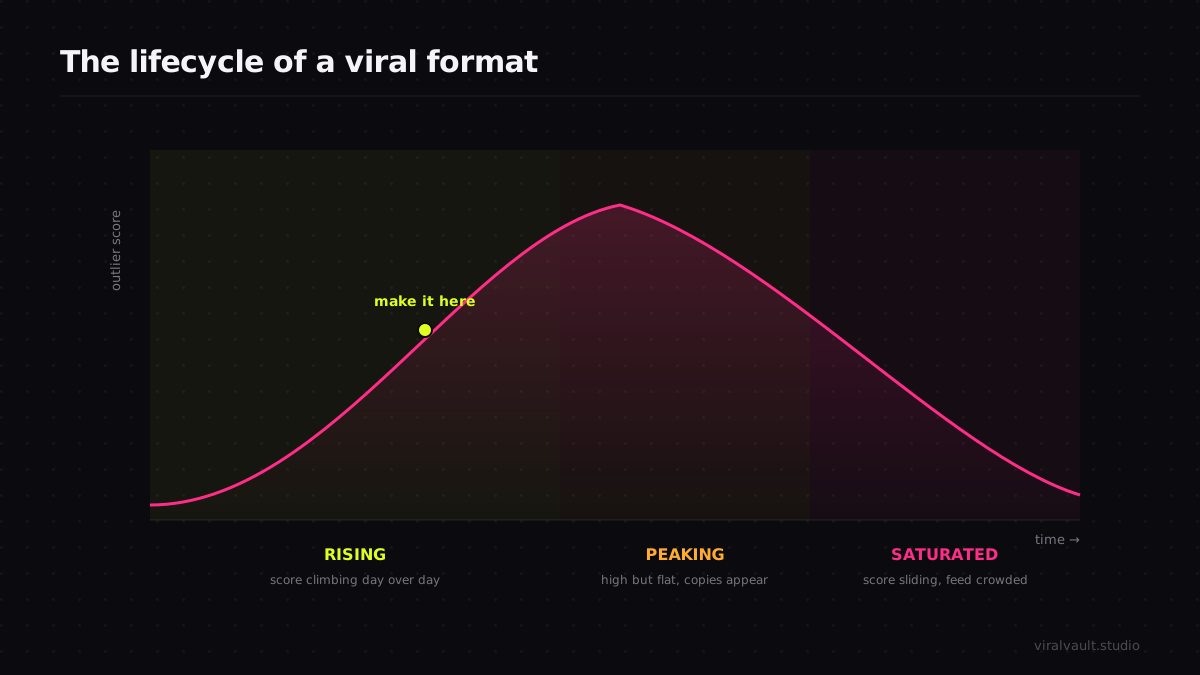
The practical consequence: a format is usually only worth making for a short window, often a handful of days. Miss it and you are not early, you are nine-hundredth.
How a dual-baseline viral content discovery tool for creators works
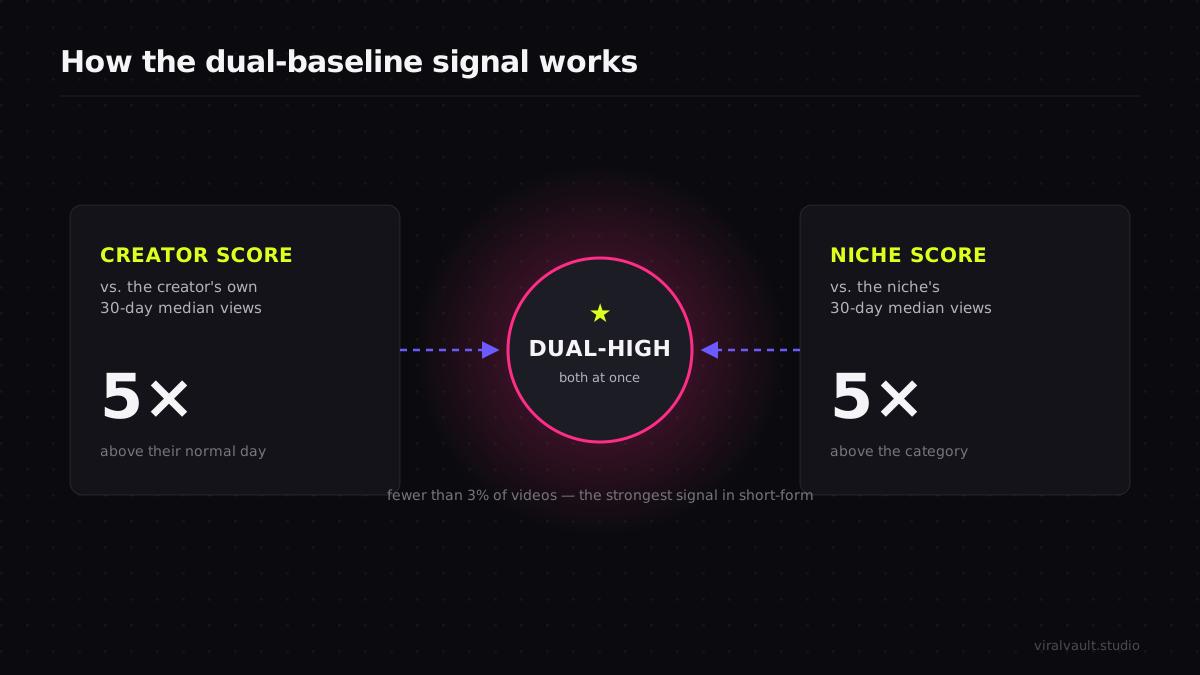
The mechanism that makes early detection possible is dual-baseline scoring. Instead of one number, every video gets two. The Creator Score measures a video against that creator's own 30-day median views — so a 500 means the video did five times the creator's typical numbers. The Niche Score measures the same video against the niche's 30-day median — so a 500 means it did five times what an average video in that category gets.
One number hides the thing you most need to know. Five times a mega-account's median might still be a forgettable format that only worked because the account is enormous. Five times the niche median on a small account is the opposite: a structure strong enough to outrun its own distribution. You want the structures that travel regardless of who posts them, and only two baselines let you see them.
When both light up at once — a high Creator Score and a high Niche Score together — ViralVault flags a Dual-High, the strongest virality signal in short-form video. It is also rare on purpose: 1,400+ videos in the index have cleared both baselines. That scarcity is the point. Clearing both takes at least five times the creator's own median and three times the niche median in the same video, so a shortlist of Dual-Highs is a far better use of an hour than scrolling the For You page hoping to recognize a pattern. The full math, including how cold-start creators and thin niches are handled, is broken down in how the Outlier Score works.
Two design choices keep the score honest. Both baselines use the median rather than the mean, computed across a rolling 30-day window, so a single freak hit never inflates the reference and makes everything after it look weak by comparison. And the system is explicit about what it does not yet know: a creator with fewer than three recent videos has no stable baseline, so the Creator Score returns null and you lean on the Niche Score alone, while a niche too thin to trust gets an approximate Niche Score, marked with a tilde, instead of a confident wrong answer. Honest gaps beat false precision when timing is the decision you are making.
Run the Outlier Score on any TikTok in your niche free, no card required, at viralvault.studio.
A 5-step workflow to find viral content before it peaks
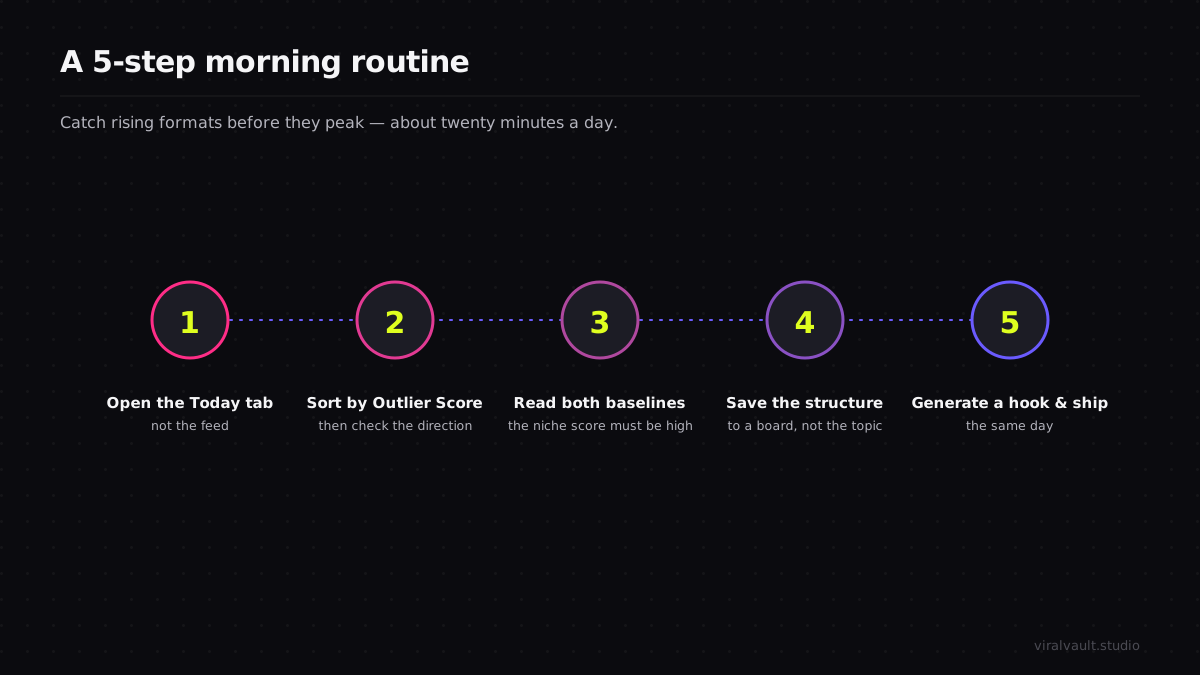
A tool is only as good as the routine you wrap around it. This one takes about twenty minutes and is built to find viral content before it peaks, not after.
- Start from the Today tab, not the feed. The Today tab curates what is hitting across 12 niches and rescores them daily, so you open to a ranked list instead of an infinite scroll. Filter to your niche first.
- Sort by Outlier Score, then check direction. A high score is necessary but not sufficient. Open the format and confirm the score has been climbing over the last few days — that is the difference between rising and already-peaked.
- Read both baselines. Confirm the Niche Score is high, not just the Creator Score. A high Creator Score alone is a community-pull story; a high Niche Score is a format story, and formats are what you can actually copy.
- Save the structure, not the video. Drop winners into a board — your content swipe file for creators — and note the structural beat (the hook shape, the reveal, the pacing), not the topic. Boards export a PNG score card so you can drop the receipt straight into a brief.
- Generate the hook and ship. Use the AI Hook Writer, which runs on GPT-4o mini, to spin five hook variants matched to the format, then make your version the same day. Speed is the entire edge.
ViralVault tip: Set a Watchlist on the two niches you actually post in. When a niche's average Outlier Score jumps 50% or more in 24 hours, you get a niche-pop alert the morning the surge starts — not the week it trends. That head start is usually the whole difference between early and ninth. See how alerts work.
If you run TikTok in the browser, the Chrome extension overlays Outlier Scores directly on the videos you are already watching so the whole loop happens without a context switch.
Run this enough mornings and it stops being research and becomes a posting system. The board fills with structures faster than you can use them, which is the goal — a backlog of proven formats to draw from on the days you have no idea what to make. When a brief lands, you are not staring at a blank feed hoping to recognize a pattern; you open the board, pull the next rising structure that fits, generate a hook against it, and ship. The twenty-minute scan front-loads the hard thinking so production is fast. Most creators run the reverse: hours agonizing over what to make and minutes actually making it. Discovery flips the ratio.
Reading the signals: Outlier Score, momentum, and saturation
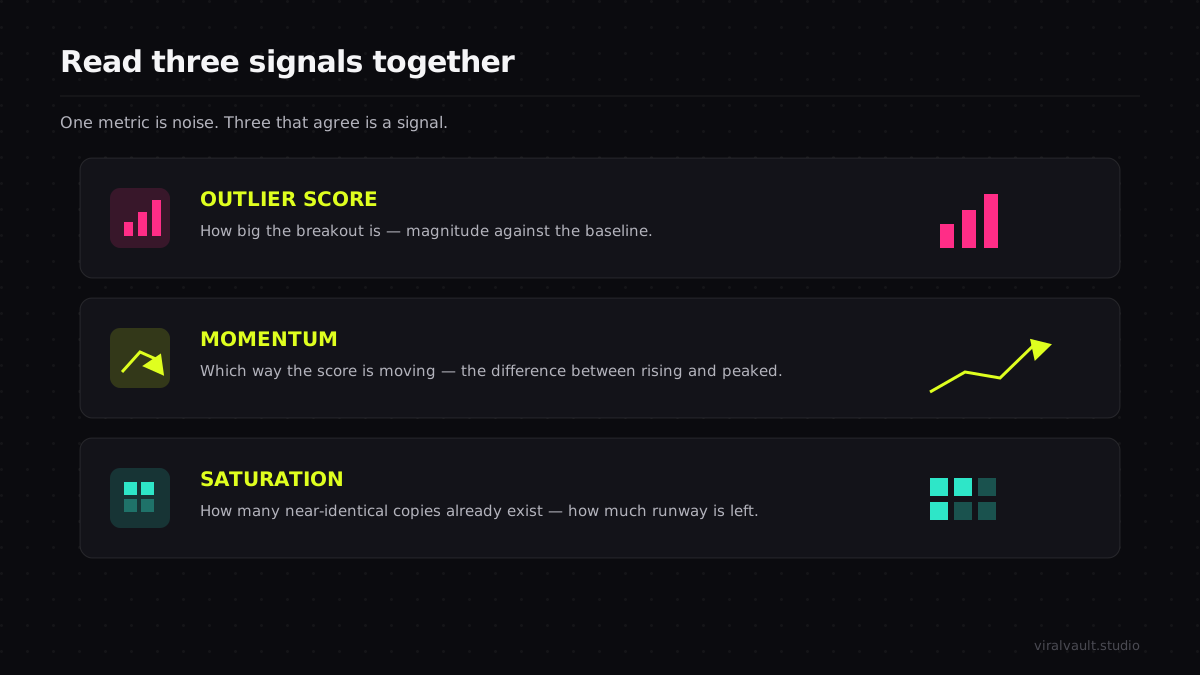
No single metric should make the call. The read comes from stacking three signals and asking whether they agree. The Outlier Score tells you the magnitude of the breakout. Momentum — the score's direction over the last few days — tells you the phase. And saturation — how many near-identical videos already exist in the niche — tells you how much runway is left.
A format with a high score, climbing momentum, and low saturation is the cleanest possible buy. A high score with flat momentum and visible copies is a coin flip: ship the same day or skip it. A high score that is sliding, with the feed already crowded, is a trap that looks like an opportunity, and it is the single most common thing creators act on too late.
Saves and shares deserve their own attention inside that read. When a video's saves and shares outrun its likes, viewers are treating it as a template or a thing worth sending — both are leading indicators that the format has legs beyond the original post. A like is a reaction; a save is intent. The engagement split is often visible before the Outlier Score has fully caught up, which makes it one of the earliest tells you have.
When the three signals disagree, weight momentum and saturation over raw magnitude. A merely good score that is climbing fast in an empty niche will out-earn a spectacular score that has gone flat in a crowded one, because you are buying the runway, not the headline number. Picture two formats: one at a Niche Score of 320 and rising with no copies in sight, the other at 700 and flat with the feed already full of lookalikes. The 320 is the better make every time. Magnitude tells you a format mattered; momentum and saturation tell you whether it still does.
For a current read on which structures are clearing this bar across niches, the running list in the formats spiking right now is refreshed weekly from the same index.
Mistakes that keep creators chasing peaks
The errors are predictable, which is good news, because predictable errors are fixable.
The first is copying the topic instead of the structure. A creator sees a finance video do numbers and makes a finance video, missing that the format — a reverse-order reveal, a specific hook shape — was the thing that actually traveled. Topics saturate; structures port across niches. Steal the beat, not the subject. The reverse-order reveal that pops in a finance niche — show the result, then walk back through the steps that produced it — works just as well in cooking, fitness, or software demos, because the tension it creates has nothing to do with money. Creators who internalize that stop starting from zero every time a niche cools off.
The second is trusting a single view count. Raw views flatten the one distinction that matters, the creator-versus-niche context, and send you chasing formats that only worked because a huge account posted them. This is exactly what dual-baseline scoring exists to prevent.
The third is acting on a weekly cadence in a daily medium. A format that was rising when you bookmarked it on Monday can be saturated by the time you sit down to make it on Saturday. The index rescores them daily for a reason; checking once a week guarantees you arrive at the peak, never before it.
The fourth is ignoring the niche median entirely. A "viral" number in one category is a slow Tuesday in another, and median Outlier Scores vary wildly between niches — the niche-by-niche median report shows just how far apart they sit. Without that anchor, you cannot tell whether a video is genuinely exceptional or merely posted in an easy lane.
The fifth is treating discovery as a thing you do once, in a burst, when inspiration runs dry. Formats do not wait for your content calendar. The creators who stay early are the ones who let the system watch for them — a Watchlist on their niche, a standing five-minute morning scan — so a rising format arrives as a notification instead of a lucky scroll three days too late. Discovery is a habit with a heartbeat, not a one-time sprint.

Frequently Asked Questions
Q: How do I find viral content in my niche before it peaks? A: Start from a baseline, not a feed. Pull the videos in your niche that are over-performing relative to the niche median, then filter for the ones still gaining velocity day over day. A rising Outlier Score with climbing saves and shares means the format is early. Set a Watchlist so the next pop in your niche reaches you the morning it starts, not the week it trends.
Q: What is a dual-baseline outlier score? A: It is two numbers instead of one. The Creator Score compares a video to that creator's own 30-day median, and the Niche Score compares it to the niche median. A single view count cannot separate a two-million-view fluke on a huge account from a genuine format breakout on a small one. Dual-baseline scoring keeps the two apart, so you copy structures that actually travel.
Q: Is there a free viral content discovery tool for creators? A: Yes. ViralVault runs a free tier with 3 searches a day and no card required, which is enough to score videos in your niche, read both baselines, and save a handful to a board. Paid tiers add Watchlist alerts, the AI Hook Writer, and the Chrome extension. A free viral content discovery tool for creators is the cheapest research hour you will spend this week.
Q: How often should I check for new viral formats? A: Daily, but briefly. The index rescores them daily and the Today tab re-ranks what is hitting across 12 niches on the same cadence, so a five-minute morning scan catches rising formats while they are still early. Checking once a week is how creators end up copying a template the same day it saturates. Speed is the whole edge here.
Start finding viral content before it peaks
The takeaway is one sentence: act in the rising phase, and use two baselines to know when that is. Everything else — the Today tab, the momentum check, the engagement split, the Watchlist alert — is machinery in service of that single timing decision. Creators who win at short-form are rarely more creative than the ones who do not; they are earlier, and being earlier is a process, not a talent. A viral content discovery tool for creators turns that process into a twenty-minute morning habit instead of a guess. Spin up a free account, set a Watchlist on your niche, and let it flag the next rising format before it peaks — start at viralvault.studio.