TikTok Creator Search Insights: Find Gaps Before Competitors

Most creators read TikTok's search demand and stop there. The gaps competitors miss are the topics where demand is high but the real, proven supply is thin. Here's how to find them first.
A content gap is not an empty search result — it is a topic an audience is hunting for that none of your competitors has actually answered well, and those two things are easy to confuse. This TikTok Creator Search Insights guide is about the second, harder read: not "what are people searching" but "where is demand high while the real, proven supply is thin." That subtraction — demand minus competitive supply — is where the lanes your competitors have not filled actually live, and most creators never run it because they stop at the demand half. TikTok's own tool hands you the demand side for free. The supply side is the part everyone skips, because counting how many videos exist on a topic is not the same as knowing whether any of them work. By the end of this playbook you will be able to read demand from Creator Search Insights, measure real supply with outlier data, and find the high-demand, low-competition gaps before the creators in your niche do.
Table of contents
- Where most content gap analysis goes wrong
- What this TikTok Creator Search Insights guide measures
- How to find gaps competitors miss step by step
- Defending the gap once you have claimed it
- Frequently Asked Questions
- Find the gap before the niche does
Where most content gap analysis goes wrong
The standard version of content gap analysis tiktok creators run is a single read: open Creator Search Insights, find a topic flagged as high-demand and low-content, and call it a gap. That read is not wrong so much as half-finished, and the missing half is where competitors quietly beat you. TikTok's "low content" flag counts videos. It does not weigh them. A topic can be flagged as having little content and still be effectively claimed, because one creator already made the definitive video on it and is satisfying the entire query alone.
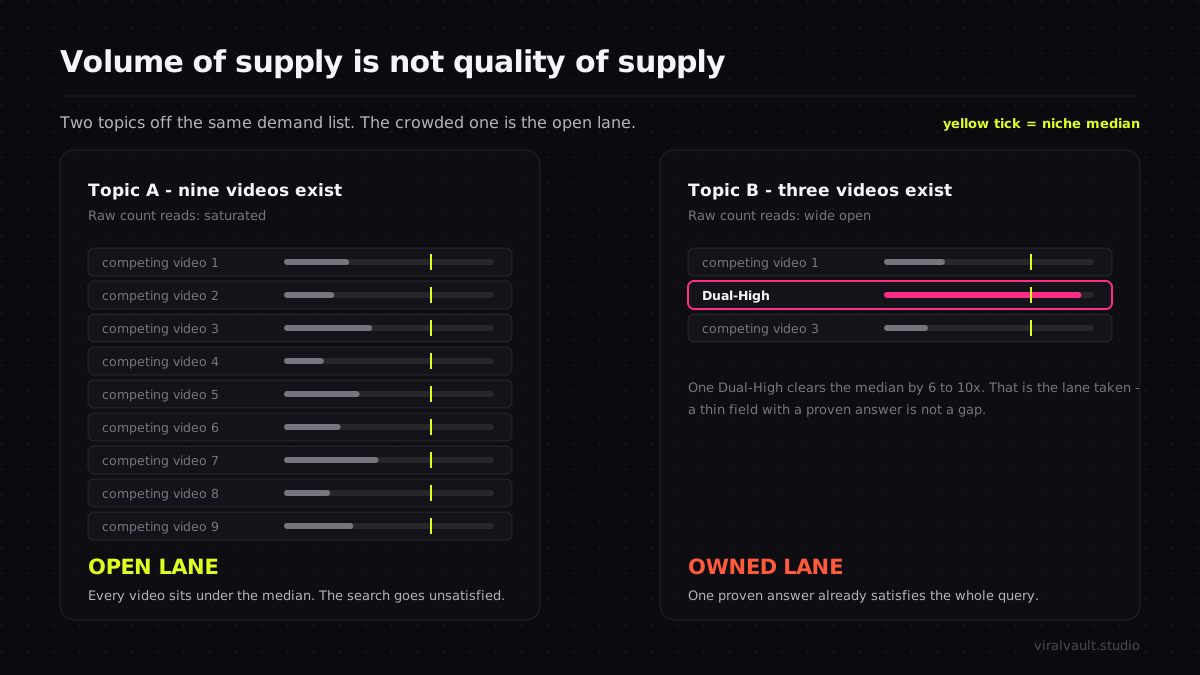
The reverse trap is more common and more costly. A topic can look completely saturated — dozens of videos, every angle apparently covered — and still be wide open, because none of those dozens actually over-performed. Volume of supply and quality of supply are different measurements, and your competitors are graded on the second one. If twenty videos exist on a topic but every one of them landed at or below its niche median, the audience is searching and not being satisfied. That is a gap hiding inside what looks like a crowded field, and a raw video count will never show it to you.
This is the blind spot in every demand-only workflow. Creator Search Insights tells you a topic is wanted, and the broader Creator Search Insights guide walks through reading that demand and pairing it with format discovery. What no in-app tool tells you is whether the existing supply is genuinely good or merely present. Counting competitors is not analyzing them. To find the gaps competitors miss, you have to measure supply the way the algorithm does — by performance, not by headcount.
What this TikTok Creator Search Insights guide measures
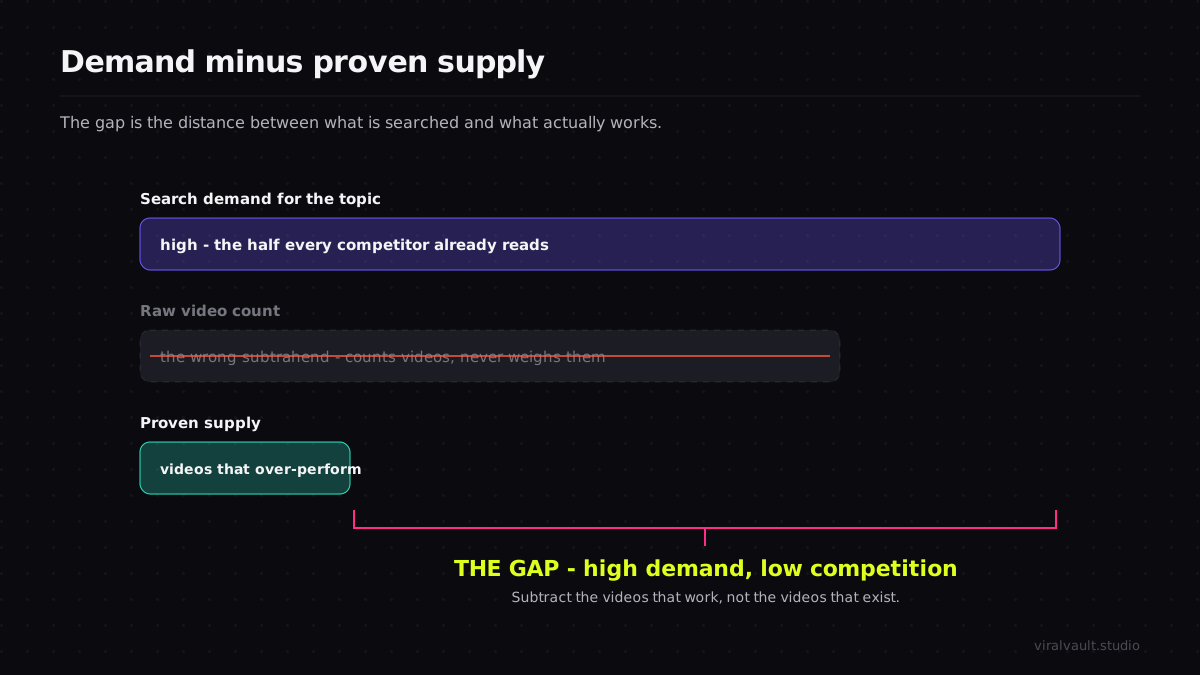
The honest formula for a content gap is demand minus competitive supply, where competitive supply means proven, over-performing videos — not the raw count TikTok shows you. Run that subtraction and the four-box demand-and-supply grid most creators use collapses into something sharper, because the supply axis stops meaning "how many videos exist" and starts meaning "how many videos actually work." A topic with high demand and high raw volume but zero over-performers reads as crowded on the surface and empty underneath. That underneath is the lane.
Measuring real supply requires a reference point the raw count cannot give you. The ViralVault index tracks 23,000+ videos across 7,800+ creators and rescores them daily, scoring each video against two baselines at once: a Creator Score comparing it to that creator's own 30-day median, and a Niche Score comparing it to the niche median. Point that at a searched topic and the supply picture inverts from "how many" to "how good." If the videos on a topic are all clustered at or below the niche median, the supply is weak regardless of its volume — the field is full of present-but-ineffective content, and the query is unsatisfied. If even one or two are Dual-High — high on both scores at once, meaning at least 5× that creator's own median and 3× the niche median, the strongest virality signal in short-form video and rare by construction — then the topic has a proven answer and the lane is taken. Most videos never clear both baselines, so the presence or absence of a Dual-High on a topic is the single clearest read on whether the gap is real.
Run each TikTok topic you are scouting through a free ViralVault search before you commit — check whether anything on it has actually over-performed, so you are claiming a gap with thin real supply, not walking into a topic a competitor already owns with one breakout video.
The reframe is what separates this from ordinary creator search insights work. TikTok itself has leaned into search as a real discovery surface — a direction documented through TikTok's newsroom — which is exactly why the demand half of this read is reliable and the supply half is where the contest is actually decided. Everyone reading the same demand tool sees the same wanted topics. The edge is not the demand list — it is the supply read your competitors are not running. While they pick the obvious high-demand topics and crowd into them, you are subtracting proven supply from demand and finding the topics that are wanted, look filled, and are actually empty where it counts. That is a gap competitors miss by definition, because the thing that hides it is the same raw video count they are looking at.
How to find gaps competitors miss step by step
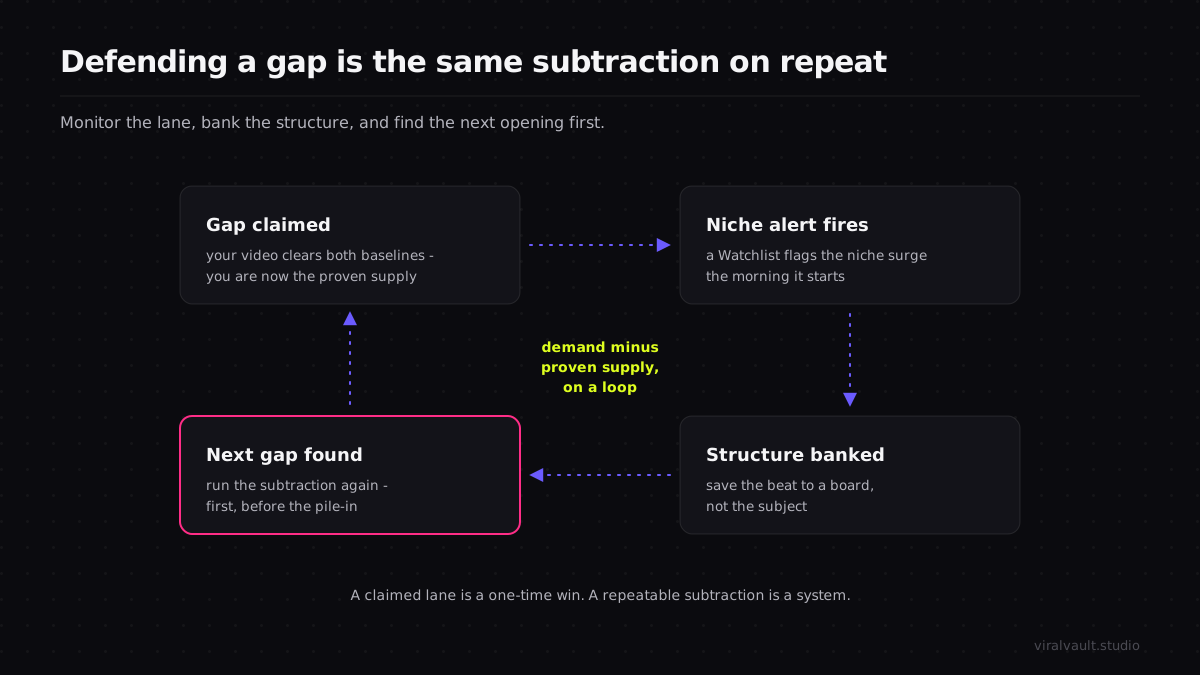
This routine takes roughly thirty minutes for a niche and is built to surface the high-demand, low-competition topics before the rest of your niche notices them. It runs the demand read and the supply read as two separate passes, then subtracts one from the other.
Step 1: Pull the demand list from Creator Search Insights
Open Creator Search Insights inside TikTok, filter to your niche, and pull every term flagged with meaningful demand into a running list — not just the ones also flagged as low-content. You want the full demand picture, including the topics that look crowded, because the most defensible gaps hide inside apparently-saturated demand. Treat the readings as directional: the tool shows relative interest and relative content levels, not a precise search volume you can paste into a spreadsheet, so read every term as "clearly wanted" rather than "wanted exactly this much." This pass is pure demand. Resist the urge to judge supply yet — you will measure that properly in the next step instead of guessing at it from the in-app content flag.
Step 2: Measure the real supply with outlier scoring
Take each demand term into ViralVault and look at the videos on that topic in your niche, sorted by Outlier Score. This is the supply read, and it is the step that turns a demand list into a gap map. For each topic, ask one question: does anything here actually over-perform? A topic where the top videos all sit at or below the niche median has weak supply no matter how many videos exist — the query is unsatisfied and the lane is open. A topic with even one Dual-High has proven supply and is effectively claimed. Sort your demand list into three buckets as you go: open lanes (high demand, no over-performers), contested lanes (high demand, one or two over-performers), and owned lanes (high demand, multiple Dual-Highs). The open lanes are your shortlist.
Step 3: Subtract to find the true gaps
Now run the subtraction. A true gap is a topic that scored high on the demand pass and came back empty on the supply pass — wanted by the audience, and answered by nothing that works. Cross off every topic with a Dual-High already on it; those are owned, and competing there means beating a proven video on its home turf as a smaller account. What remains after the subtraction is the set of high-demand, low-competition topics your competitors have not filled — including the ones that looked saturated by raw count but had no real over-performer underneath. Rank what remains by demand, because among genuinely open lanes the one with the most search interest is the one worth shooting first. This subtraction is the whole method; everything before it just produces the two numbers you subtract.
Step 4: Claim the gap with a borrowed structure
A gap is an opening, not a guaranteed win — you still have to make a video that satisfies the query, and on TikTok the structure decides that. Because the topic has no over-performer of its own to copy, borrow a proven structure from an adjacent topic instead: find a Dual-High in a neighboring lane, map its skeleton with the sound off — where the hook lands, what question it plants in the first two seconds, the order information is revealed, where the payoff is withheld — and port that structure onto your open topic. Topics saturate; structures travel, so a reveal shape that over-performed on a nearby subject carries onto your gap cleanly. Place the searched phrase in your title, on-screen text, and spoken hook so TikTok's search matches the video to the demand you found. The AI Hook Writer spins five variants — contrarian, listicle, POV, curiosity, and meme — to fit the phrase to the borrowed structure fast.
Step 5: Ship first and hold the lane
Speed is the entire point of finding a gap before competitors. A lane that is open today is open precisely because nobody has shot it yet, and that window closes the moment one strong video lands — which might be yours or might be a competitor running the same analysis. Ship your version the day you find the gap, not the following week. After posting, judge it against your own 30-day median and the niche median rather than the raw view count; clearing either baseline by 2x or more means your video is now the proven supply on that topic. At that point the subtraction has flipped in your favor: you are the Dual-High a competitor will find when they finally run their own supply read, and the gap you found is now a lane you own.
Defending the gap once you have claimed it
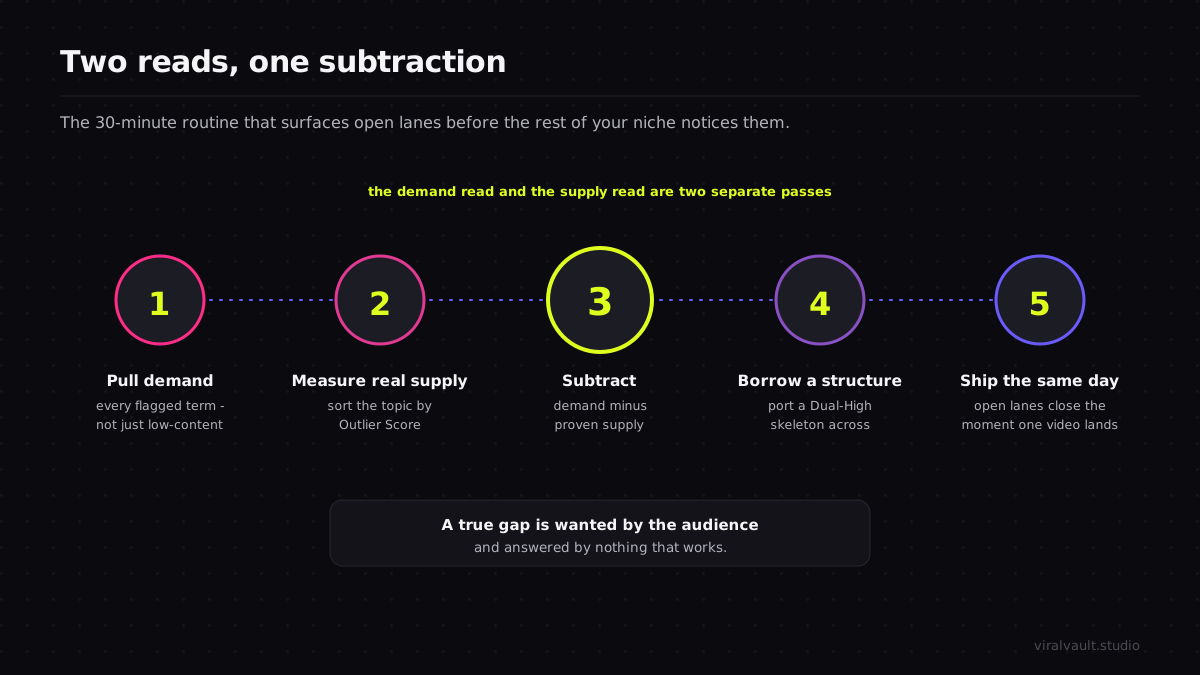
Finding the gap first is only valuable if you hold it, and the same data that found it tells you when it is under threat. The risk after you ship is that your video proves the topic works and competitors pile in behind you, turning your open lane into a contested one. The defense is to watch the supply read on that topic the way you ran it in the first place — except now you are watching for someone else's over-performer appearing where there was none. A Watchlist on the niche surfaces that shift early, and for teams running this across many niches at once the agency workflow shows how to operationalize the gap-finding loop at scale rather than topic by topic.
ViralVault tip: Set a Watchlist on the niche where you claimed a gap. If the niche's average Outlier Score jumps 50% or more in 24 hours, you get a niche-pop alert the morning the surge starts — your early warning that a topic in that lane is heating up and competitors are about to crowd in, so you can ship your follow-up before they arrive. Start a free account to set one.
The deeper defense is to keep finding the next gap faster than competitors find the last one. A single claimed lane is a one-time win; a repeatable subtraction is a system. Save every gap you find and every structure you borrow to a board, note the structural beat rather than the subject, and that board becomes a running shortlist of proven shapes you can drop onto the next open topic the moment your supply read surfaces it. The creators who own their niches are not the ones with the best single videos — they are the ones running demand-minus-supply on a loop while everyone else is still reading demand alone. The wider method for catching rising structures before they saturate lives in the viral content discovery guide, and it pairs directly with the gap subtraction here: one finds the open topic, the other finds the shape that wins it.
Frequently Asked Questions
Q: What is content gap analysis on TikTok? A: It is the process of finding topics an audience is searching for that no creator has answered well. Most versions stop at demand — pulling high-search, low-content topics from Creator Search Insights. The complete version subtracts real, proven supply from that demand, because a topic can look filled by raw video count while none of those videos actually over-perform, leaving the query unsatisfied and the lane open.
Q: How do I find content gaps competitors miss on TikTok? A: Run two reads, then subtract. Pull demand from Creator Search Insights filtered to your niche, then measure real supply by sorting each topic by Outlier Score to see whether anything over-performs. A topic with high demand and no Dual-High videos is an open lane your competitors missed, even if it looks crowded by raw count. Rank the open lanes by demand and ship the strongest first.
Q: Does Creator Search Insights show how much competition a topic has? A: It shows a relative content level — roughly how many videos exist — but not whether those videos work. A topic flagged as low-content can be owned by one strong creator, and a topic that looks saturated can be wide open if none of its videos over-performed. To read true competition you need a performance baseline like the dual-baseline Outlier Score, not a raw video count.
Q: Can a topic be a content gap if lots of videos already exist on it? A: Yes, and these are the most defensible gaps. Volume of supply is not quality of supply. If twenty videos exist on a topic but every one landed at or below its niche median, the audience is searching and not being satisfied, so the gap is real. Competitors miss these because the raw video count they look at hides the absence of any genuine over-performer.
Q: How fast do TikTok content gaps close? A: Quickly in active niches — a lane stays open only until one strong video lands on it, which can happen within days. That is why the subtraction is paired with speed: ship the day you find the gap, then watch the niche's average Outlier Score for the 50%-in-24-hours jump that signals competitors crowding in. Finding the gap first only pays off if you claim it before the field fills.
Find the gap before the niche does
The move that separates this TikTok Creator Search Insights guide from every demand-only workflow is the subtraction: demand from the search tool, minus the real, proven supply your competitors never bother to measure. A topic everyone can see is searched is not a gap if a Dual-High already answers it, and a topic that looks crowded is wide open if nothing on it actually works. Read demand from Creator Search Insights, measure supply with the dual-baseline Outlier Score, subtract one from the other, and the high-demand, low-competition lanes your competitors miss fall straight out of the math. Then ship first, hold the lane, and run the same subtraction on the next topic before anyone else does. Pull your niche's demand list, score the real supply underneath it, and claim the gaps the field has not — start free at viralvault.studio.