Content Intelligence vs Social Media Analytics Explained

These two categories sound alike and do opposite jobs. One looks forward to what you should post next; the other looks back at how your last post did. Here is the difference, and when each one earns its place.
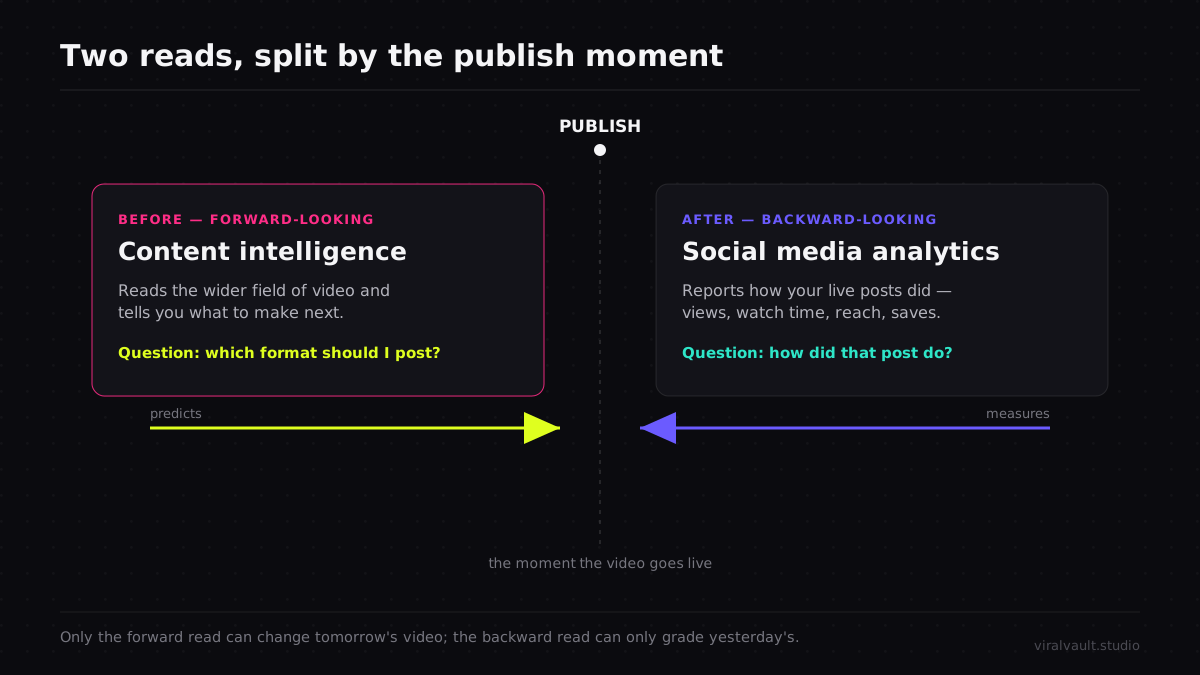
Two tools sit on most creators' screens, they sound almost identical, and they do opposite jobs. Content intelligence is forward-looking: it reads which formats are working right now and tells you what to make next, before you publish. Social media analytics is backward-looking: it reports how your posts performed after they went live. Confusing the two is why so many creators have a dashboard full of last week's numbers and still no idea what to post tomorrow. The cleanest way to feel the gap is the pre-publish read — a viral score tool for social media posts grades a format's strength before you commit to it, which no post-publish report can do. This guide draws the line between the two categories, explains why the difference decides whether you grow or just measure your own decline, and shows how to use each one for the job it was actually built for.
Table of contents
- What content intelligence actually is
- What social media analytics actually is
- Why the difference matters for what you post
- How a viral score tool for social media posts fits in
- Frequently Asked Questions
- Choosing the right read for the job you are doing
What content intelligence actually is
Content intelligence is the discipline of reading signal across many creators and many videos to work out which formats are over-performing, and surfacing that read before you produce anything. The defining word is before. It answers a forward question — what should I make next, and is this format still early enough to copy — rather than reporting on something you already shipped. Its raw material is not your own account; it is the wider field of short-form video, scored so a genuine breakout stands apart from an ordinary day.
The mechanism that makes content intelligence useful is a baseline, not a leaderboard. A raw view count cannot tell a real format breakout from a big account's slow Tuesday: two million views on a two-million-follower creator is unremarkable, while two million on an eighty-thousand-follower account is a structure that broke a ceiling it had no business breaking. Content intelligence measures every video against how its creator and its niche normally perform, so the structurally strong video rises to the top where you can actually learn from it. That is a fundamentally predictive read — it points at the format you should build next, not the one you already built.
The output is a decision, not a report. Good content intelligence hands you a repeatable structure — a reverse-order reveal, a two-second visual hook, a specific way of withholding the payoff — that you can take into your next shoot. Short-form moves fast enough that this forward read has a shelf life measured in days; TikTok's own newsroom documents how quickly search and trend behavior shifts on the platform. Catch the rising format while it is early and you are first; read it a week late and you are the ninth copy in the feed.
What social media analytics actually is
Social media analytics is the measurement layer that sits on the other side of publishing. It reports what already happened to content that is live: your views, watch time, reach, follower change, likes, comments, and saves, usually broken out by post and by date. The defining word here is after. It answers a backward question — how did that do — with precision and detail, across your own accounts and sometimes your competitors'.
That backward read is genuinely valuable, and any fair comparison has to say so plainly. Knowing which of your posts held attention, which time slots land, and how a format performed once it shipped is real feedback, and it is the cheapest research a creator has. Analytics tells you the truth about your own history, and a creator who never reads their own retention curve is flying blind in a different way. The category is not weak; it is simply pointed at the past, by design.
The limit only appears when you ask analytics to do content intelligence's job. A post-publish report can tell you a video did well; it cannot tell you which format to make before you make it, because it has no data on a video that does not exist yet. It measures outcomes, not opportunities. Lean on analytics alone and you optimize last week's decision over and over while the formats that would actually grow you rise and saturate without ever appearing in your dashboard — because they never ran on your account.
Why the difference matters for what you post
The difference matters because the two categories answer questions at opposite ends of the production cycle, and most creators only own one end. The pre-publish vs post-publish split is not a technicality — it decides whether your tooling can change tomorrow's video or only grade yesterday's. Analytics improves the decision after you have already spent the effort. Content intelligence improves the decision before you spend it, which is the only point at which the cost of a wrong format is still zero.
Think of a single video's life. Before the shoot, the question is which format — and only a forward-looking read can answer it, because there is nothing to measure yet. After it posts, the question is how did it do — and only a backward-looking report can answer that, because now there is data. A creator running on analytics alone is permanently answering the second question and guessing at the first. The growth ceiling is structural: you cannot analyze your way to a format you never tried.
This is also why the two are complements, not rivals. The strongest workflow uses content intelligence to choose the format and analytics to confirm the call, then feeds that confirmation back into the next choice. For a wider map of where the forward-looking tools sit and how they differ from the measurement layer, the roundup of the best viral content discovery tools for 2026 lays out the field.
You can run a forward-looking read on any TikTok in your niche free, with no card required, at viralvault.studio.
How a viral score tool for social media posts fits in
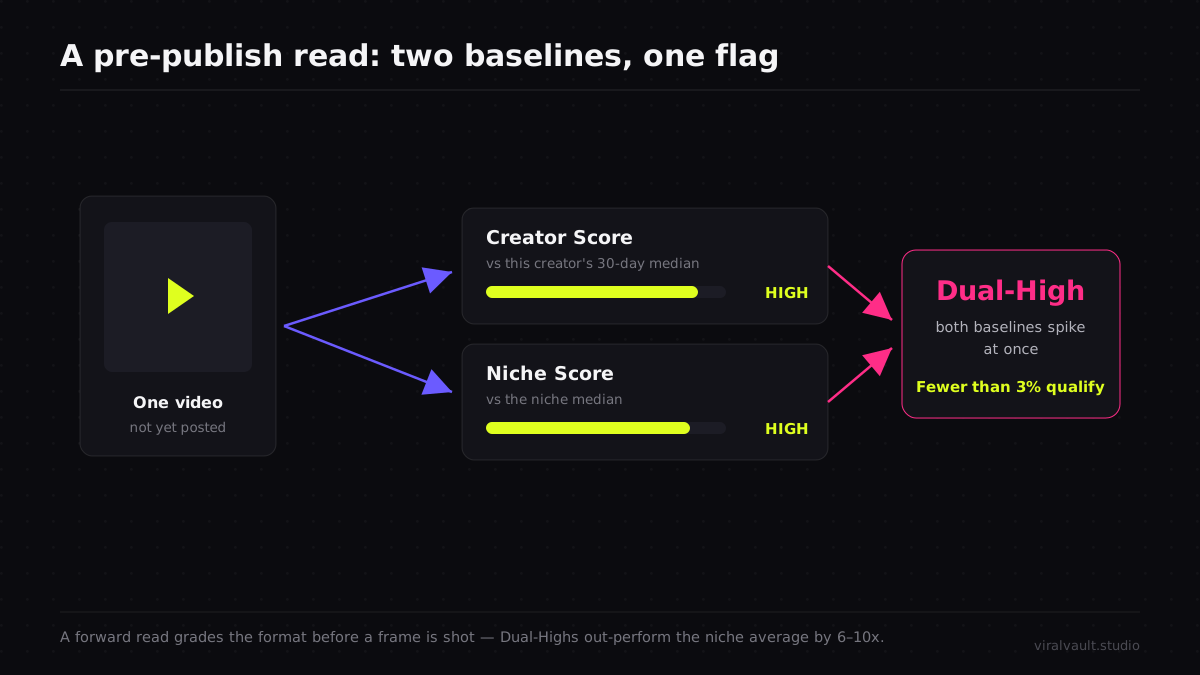
The cleanest piece of content intelligence a creator can act on is a viral score tool for social media posts: paste a video, get a read on how strong the format is relative to its creator and its niche, and decide whether to copy it — all before you have shot a frame of your own. ViralVault's dual-baseline Outlier Score does exactly this. Every video gets a Creator Score, measured against that creator's own 30-day median, and a Niche Score, measured against the niche median, so a small-account breakout is never buried under a mega-account's raw numbers. The full method is broken down in how the Outlier Score works.
The two baselines together are what make the read predictive rather than descriptive. When both light up at once, ViralVault flags a Dual-High — 1,400+ videos in the index have cleared both. That is the strongest virality signal in short-form video, and it is the kind of forward read no post-publish dashboard can produce, because it grades a format's strength independent of whose account it ran on. The index behind it tracks 23,000+ videos across 7,800+ creators and rescores them daily, so the forward read stays current with a feed that moves in days.
ViralVault tip: Use the two categories in sequence, not in competition. Run the format through a dual-baseline score before you shoot to decide whether it is worth making, then read your own analytics after to confirm the call landed — and feed that confirmation into your next pre-publish read. Start the forward half free at viralvault.studio.
Frequently Asked Questions
Q: What is the difference between content intelligence and social media analytics? A: Content intelligence is forward-looking: it reads which formats are working across many creators and tells you what to post next, before you publish. Social media analytics is backward-looking: it measures how your own posts performed after they went live. One predicts the right decision; the other grades the decision you already made. Used together, they cover the full production cycle.
Q: Is a viral score tool the same as analytics? A: No. A viral score tool for social media posts is a pre-publish read — it grades a format's strength against creator and niche baselines before you make your own version. Analytics is a post-publish read that reports views, watch time, and reach on content that is already live. The score helps you choose what to make; analytics tells you how the made thing did.
Q: Do creators need both content intelligence and analytics? A: Most do. Analytics confirms what worked on your own account, which is essential feedback, but it cannot point you at a format you have not tried yet. Content intelligence fills that gap by reading the wider field before you commit. The pre-publish vs post-publish pairing is the full loop — choose with intelligence, confirm with analytics, then choose again.
Choosing the right read for the job you are doing
The whole distinction fits in one line: content intelligence tells you what to post next, and social media analytics tells you how the last thing did. They are not competitors — they are the two halves of a single loop, and most creators only own the backward half. Reading your own analytics is necessary, but it can only ever optimize decisions you have already made; it cannot hand you a format you never tried. A forward-looking read closes that gap, and the sharpest version of it is a viral score tool for social media posts that grades a format's strength before you commit the effort. Run discovery and measurement in sequence — choose with intelligence, confirm with analytics, repeat — and you stop re-optimizing the past. Spin up a free account, score the next format you are tempted to copy before you shoot it, and let the forward read do the half your dashboard never could, starting at viralvault.studio.