How to Repurpose Viral Content for Multiple Platforms

One TikTok that pops is not one post — it is a proven structure you can run across Reels, Shorts, and carousels all week. Here is the full atomization system.
Most creators treat a viral TikTok as a lottery ticket — cash it once, then go looking for the next one. That is the expensive way to work. The video did not break through because of its topic; it broke through because of its structure, and a structure can be run again. Learning how to repurpose viral content for multiple platforms is really about extracting that winning structure once and atomizing it — the same hook shape and reveal rebuilt as a Reel, a Short, a carousel, and a written post across a full week. This is not reposting the identical clip to four apps and hoping the algorithm forgives you. It is a hub-and-spoke system: one proven format at the center, five or six native spokes radiating out, each rebuilt for where it lives. By the end of this guide you will have a repeatable workflow that turns a single outlier into a week of content without starting from a blank page once.
Table of contents
- Why repurposing beats reposting
- Find the winning structure once
- How to repurpose viral content for multiple platforms
- A 7-day repurposing workflow from one TikTok
- Rebuilding the hook for each platform
- Mistakes that turn repurposing into spam
- Frequently Asked Questions
Why repurposing beats reposting
Reposting is the lazy version, and the platforms are built to punish it. Lift a TikTok with the watermark still baked in, drop it on Reels and Shorts, and the recommendation systems read the artifacts — the logo, the aspect ratio, the audio fingerprint — as recycled and throttle the reach. TikTok has been explicit that it ranks for relevance and originality rather than raw reposting, as its own newsroom documents across its recommendation guidance. You end up with the same video buried on three feeds instead of one. The clip is the same; the result is worse.
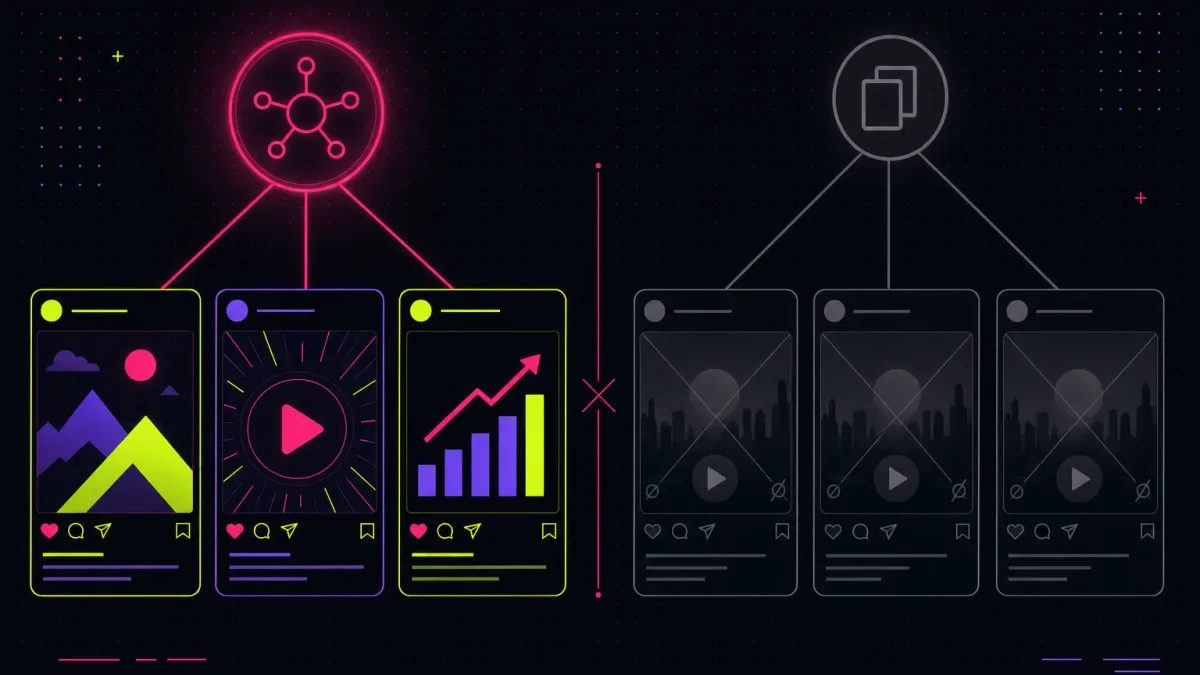
Repurposing works because it travels at the level the algorithm actually rewards: the structure. A reverse-order reveal, a two-second visual hook, a specific way of withholding the payoff until the last beat — those beats are not tied to TikTok and they are not tied to the original topic. They are a pattern, and a pattern can be re-shot vertically for Reels, re-cut tighter for Shorts, and re-drawn as a swipeable carousel without a single frame in common. Same skeleton, native skin on every platform.
There is a compounding reason too. A format that earned an outlier number once has already cleared the hardest test — it beat the feed instead of getting lost in it. Reusing a proven structure is the closest thing short-form has to a sure bet, because you are not gambling on whether the idea works; you already have the receipt. The only open question is execution per platform, and that is a production problem, not a creative one.
This reframes the whole job. Instead of asking "what do I post today," you ask "which proven structure am I running this week, and where does each spoke land." That mindset is the core of how to repurpose viral content for multiple platforms — and a genuine content repurposing workflow is the difference between a creator who produces one good video a week and one who produces seven, off the same idea, with the same hours.
Find the winning structure once
Repurposing only pays if you start from a structure that is actually proven, which means the first step happens before you shoot anything. You need to identify a format that over-performed — not a video you liked, a video the numbers liked. That distinction is the whole foundation, and it is measurable.
A raw view count cannot tell you whether a format is worth reusing. Two million views on a creator with two million followers is an ordinary day; two million on a creator with eighty thousand followers is a structure strong enough to outrun its own distribution. The second one is the format you want to run all week. The first is noise. Telling them apart is exactly what a viral content discovery tool for creators is for — and the full discovery method is broken down in this guide, which is worth reading first if format-finding is new to you.
ViralVault scores this with two baselines instead of one. The Creator Score measures a video against that creator's own 30-day median, and the Niche Score measures it against the niche's 30-day median. When both light up at once, the index flags a Dual-High — the strongest virality signal in short-form video, and rare on purpose: 1,400+ videos in the index have cleared both, which takes at least 5x the creator's own median and 3x the niche median in the same video. That is your shortlist. You do not want to spend a week of production atomizing a format that merely did fine; you want the structure that broke the niche open.
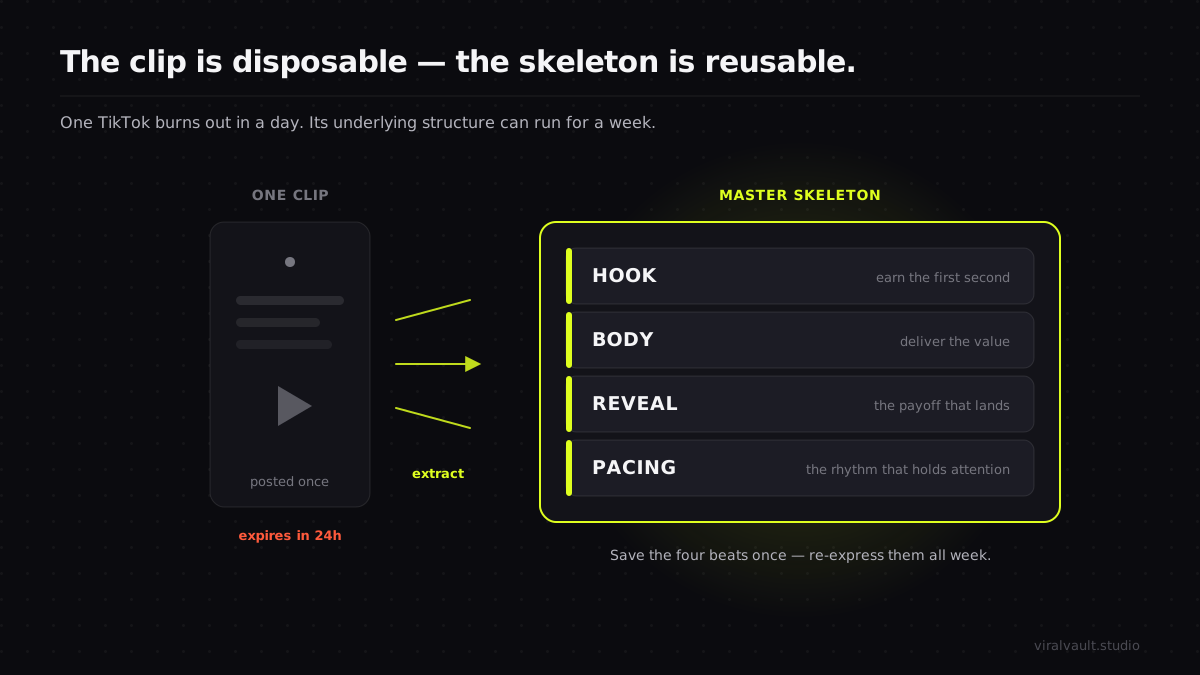
Once you have a candidate, capture the structure, not the clip. Write down the beats: what the hook does in the first two seconds, where the payoff sits, how the pacing builds, what the reveal is. A board in ViralVault holds these as a running swipe file and exports a PNG score card, so the proof travels into your brief alongside the breakdown. That captured skeleton — hook, body, reveal, pacing — is the master you will rebuild five different ways. Everything downstream is a remix of it.
To find candidates worth atomizing, run the Outlier Score on any TikTok in your niche free, no card required, at viralvault.studio.
How to repurpose viral content for multiple platforms
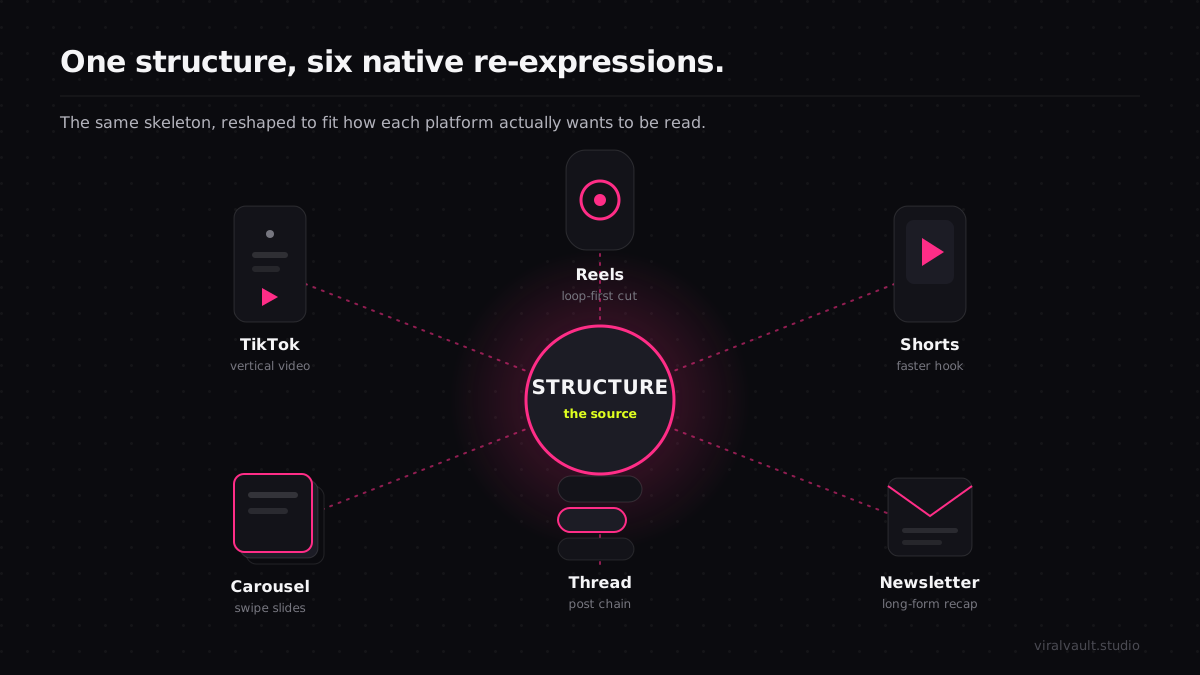
With one proven structure in hand, the work becomes a mapping exercise: take the skeleton and decide what each platform's native version looks like. This is where most creators go wrong by assuming repurposing means "same length, same cut, different app." It does not. Each surface has a format it rewards, and the structure has to be re-expressed in that format's grammar — not merely re-uploaded into it.
Here is the core map for turning one TikTok structure into a full week of native posts.
| Platform | Native format | How the structure ports |
|---|---|---|
| TikTok | The original vertical video | The master cut — hook in 2s, full reveal, native captions |
| Instagram Reels | Vertical, slightly polished | Same beats, cleaner edit, no TikTok watermark, on-platform audio |
| YouTube Shorts | Vertical, tighter | Cut 10 to 15% shorter, front-load the reveal, searchable title |
| Carousel post | Swipeable static frames | Hook on slide 1, body across the middle, payoff on the last slide |
| Written post or thread | Text-first | The reveal as a one-line opener, the steps as a numbered list |
| Newsletter or long caption | Expanded prose | The format as a mini case study with the why behind it |
The logic is consistent across every row: the hook leads, the body carries, the reveal pays off, but the medium changes the delivery. A two-second visual hook on TikTok becomes a bold first slide on a carousel and a single curiosity-gap sentence at the top of a thread. The withheld payoff that works as a final-frame reveal in video becomes the last slide of the carousel and the punchline of the post. You are not translating word for word; you are re-staging the same tension for a different room.
That is the actual meaning of a cross-platform content strategy — not "be everywhere," but "express one proven idea in the native language of each place you are." Five spokes off one hub, each one shaped to win where it lives. The structures that travel cleanest tend to be the evergreen ones; the formats blowing up right now are a good source of skeletons that already port across niches and surfaces.
ViralVault tip: Before you atomize a format, set a Watchlist on the niche it came from. When that niche's average Outlier Score jumps 50% or more in 24 hours, you get an alert the morning the surge starts — which tells you whether the structure you are about to spend a week on is still rising or already cooling. See how Watchlist alerts work.
A 7-day repurposing workflow from one TikTok
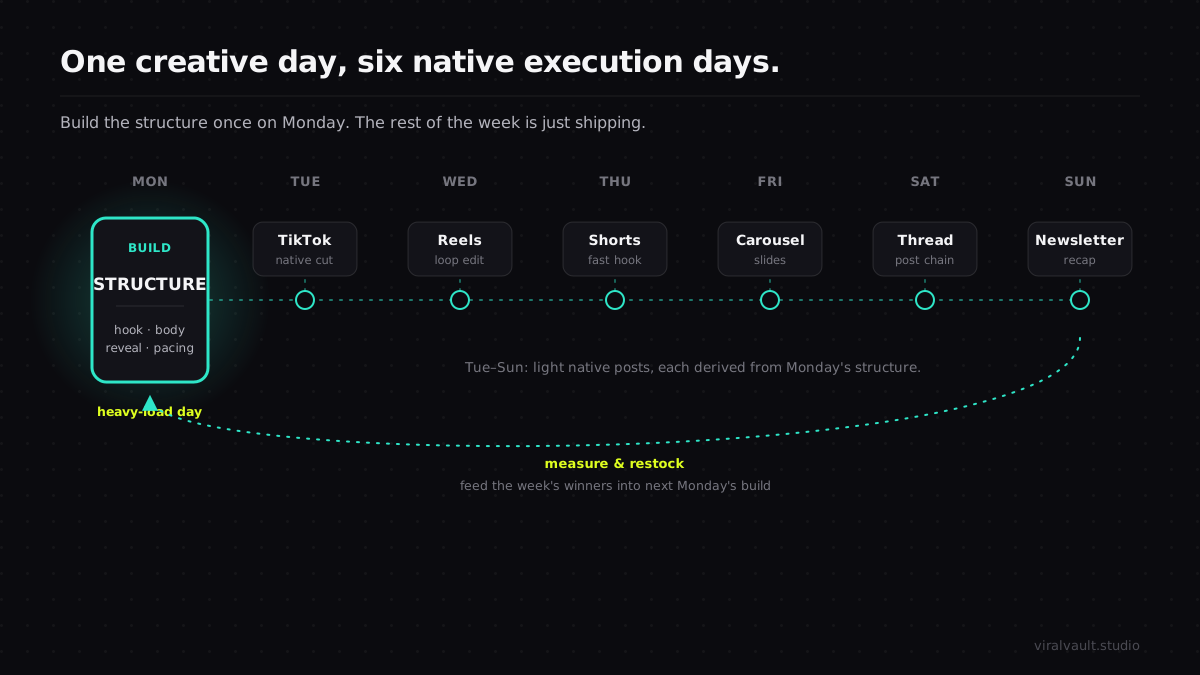
The theory only matters if it fits in a week without burning you out. This is the production schedule — one proven structure on Monday, a full feed by Sunday, no blank pages in between. The point of a content repurposing workflow is that the hard creative thinking happened once, up front, so the rest of the week is execution.
Day 1: Lock the master structure
Pick the Dual-High format you are running this week and write the skeleton down in plain language — the hook, the body beats, the reveal, the pacing. Shoot or finalize the TikTok version first, because it is the densest expression and everything else is a reduction or expansion of it. This is the only day that requires real creative decisions; protect it.
Day 2: Cut the Reels and Shorts spokes
Re-export the vertical video twice, natively. For Reels, strip any TikTok watermark, swap to on-platform audio, and tighten the edit slightly. For Shorts, cut 10 to 15% shorter and front-load the reveal, because Shorts viewers bail faster and the platform indexes the title for search. Same structure, two native cuts, zero new ideas required.
Day 3: Build the carousel
Translate the skeleton into static frames. Slide one is the hook — the same scroll-stopping promise, written bold. The middle slides carry the body, one beat per slide. The final slide is the reveal you withheld. A carousel forces you to articulate the structure explicitly, which often sharpens your understanding of why the original worked.
Day 4: Write the text spoke
Turn the format into a written post or thread. The reveal becomes your one-line opener, the body beats become a numbered list, and the result you teased becomes the payoff at the end. This is where "turn one video into many" stops being a slogan and becomes obvious — the same skeleton reads completely differently as text, and reaches an audience that scrolls captions instead of video.
Day 5: Expand into the long form
Take the format somewhere with room to breathe — a newsletter section, a long caption, a short blog note. Here you explain the why: why this structure works, what tension it creates, where else it ports. You are no longer just running the format, you are teaching it, which positions you as someone who understands the mechanics, not just someone who got lucky once.
Day 6: Cross-link and reshare
Point the spokes at each other. The carousel caption nods to the full video; the thread links the newsletter; the newsletter embeds the Short. One idea, now a small web of content that sends attention between surfaces instead of stranding it on one. This is the compounding step most creators skip entirely.
Day 7: Measure and restock
Score the spokes. Which platform did the structure travel best on? Feed that back into next week's pick. Then open your board and pull the next rising Dual-High so Monday is not a blank page. The workflow is a loop, not a sprint — the board stays one structure ahead of you so you never start from zero.
Rebuilding the hook for each platform
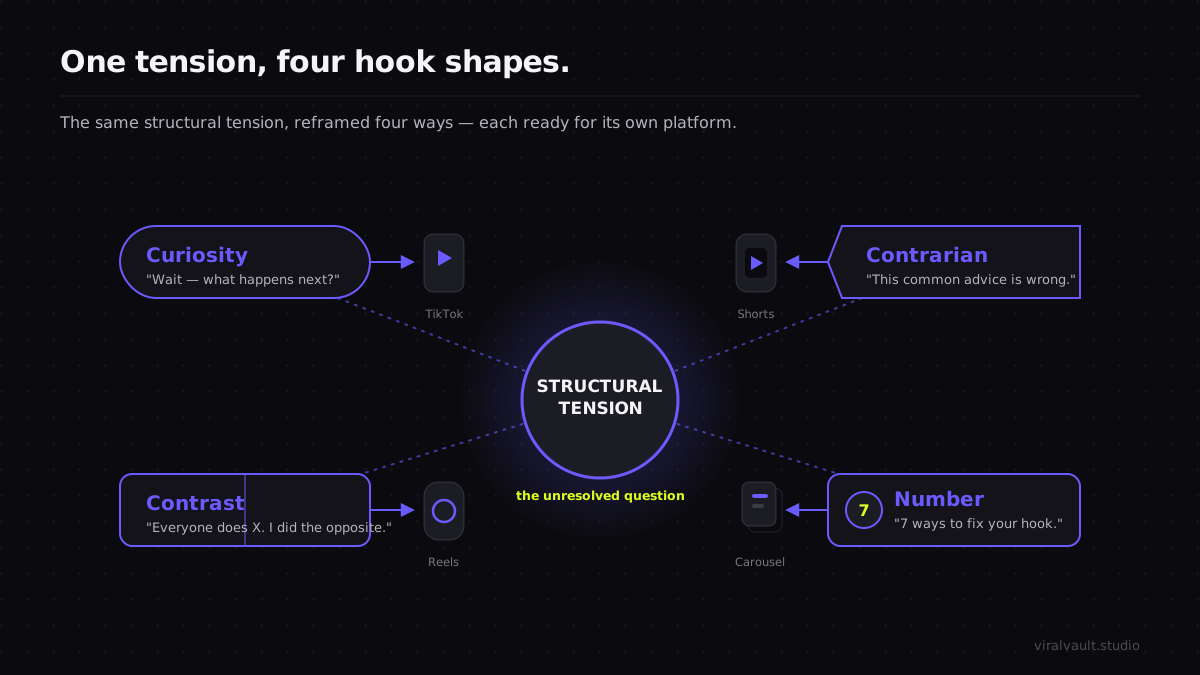
The single most platform-sensitive part of any repurpose is the hook, because the hook is what each algorithm tests hardest and what each audience encounters first. Reuse the exact same opening line across all six surfaces and most of them will underperform — not because the structure is wrong, but because the delivery is foreign to the medium. The structure ports; the hook has to be rebuilt.
A hook does one of a few jobs — opens a curiosity gap, leads with contrast, states a contrarian take, or drops a hard number — and which one lands depends on the surface. A two-second visual hook carries a TikTok or Reel. A bold declarative line has to carry a carousel's first slide, because there is no motion to do the work. A curiosity-gap sentence carries a thread, where the reader decides in one line whether to keep going. The underlying tension is identical; the form changes per platform.
This is exactly the kind of per-surface rewriting the AI Hook Writer is built for. Point it at the original format and it spins five hook variants — contrarian, listicle, POV, curiosity, and meme — each a different angle on the same structure, so you can match the right hook shape to each spoke instead of forcing one line to work everywhere. Running on GPT-4o mini, it turns the most tedious part of repurposing into a thirty-second step, and the format-aware mode locks the variants to the structural pattern you are reusing rather than drifting off into generic openers.
The rule underneath all of it: keep the structural tension constant, vary the hook's form to fit the room. A reverse-order reveal stays a reverse-order reveal whether it is a video, a carousel, or a thread — but the first thing the audience sees should always be written in that surface's native grammar.
Mistakes that turn repurposing into spam
Done badly, repurposing reads as spam and trains your audience to scroll past you. The failure modes are predictable, which means they are avoidable.
The first and worst is reposting the literal clip. Lifting the watermarked TikTok onto Reels and Shorts gets the reach throttled and signals to followers who track you across platforms that you have nothing new to say. The fix is the whole premise of this guide: port the structure, rebuild the asset natively for each surface.
The second is ignoring native format. A horizontal cut jammed into a vertical slot, a TikTok caption pasted verbatim into a carousel, a thread that is just the video script with line breaks — each one tells the algorithm and the audience that you did not bother. Every spoke has to look like it was made for the place it lives, even though the idea behind it is shared.
The third is repurposing a format that was never proven. Atomizing a video you liked but that only did average numbers is a week spent multiplying a mediocre result. This is why the find-the-structure step is non-negotiable: a real cross-platform content strategy starts from an outlier with two baselines behind it, not a hunch. Multiply a winner, not a maybe.
The fourth is posting all six spokes in the same hour. Repurposing is supposed to spread one idea across a week, not flood every feed at once. Spacing the spokes is what gives a single structure the chance to find different audiences on different days — and it is what keeps your output looking like a content plan instead of a copy-paste dump.
The fifth is never measuring which spoke worked. If you do not track which platform the structure traveled best on, you cannot improve the pick next week. The loop only compounds if Sunday's measurement feeds Monday's choice. Repurposing without measurement is just more posting; repurposing with it is a system that gets sharper every week.

Frequently Asked Questions
Q: How do I repurpose viral content for multiple platforms without it looking like spam? A: Port the structure, not the clip. Identify the proven format's beats — hook, body, reveal, pacing — then rebuild each one natively: a vertical video for Reels and Shorts, swipeable frames for a carousel, a numbered list for a thread. Space the posts across a week and strip every watermark. The shared idea travels; the asset is made fresh for each surface, so nothing reads as recycled.
Q: What does it mean to repurpose content instead of repost it? A: Reposting uploads the identical file to several apps, where recommendation systems detect the watermark and audio fingerprint and throttle the reach. Repurposing extracts the winning structure and rebuilds it natively for each platform — same skeleton, different execution. Reposting copies the clip and gets buried; repurposing copies the format and travels clean, because the algorithm rewards the structure, not the file.
Q: How do I know which video is worth turning into a week of content? A: Score it against two baselines, not raw views. ViralVault's Creator Score compares a video to the creator's own 30-day median and the Niche Score compares it to the niche median; when both spike, it flags a Dual-High — 1,400+ videos in the index have cleared both. Atomize a Dual-High, not a video that merely did fine.
Q: How many platforms should one TikTok be repurposed across? A: Five or six is a realistic week from one structure — the original TikTok, Instagram Reels, YouTube Shorts, a carousel, a written post or thread, and an expanded long-form piece. The cap is not the platform count, it is whether each spoke can be made genuinely native. A great Reel and a great carousel beat six lazy uploads. Add a surface only when you can express the structure properly there.
Q: Is there a free tool to find formats worth repurposing? A: Yes. ViralVault runs a free tier with 3 searches a day and no card required, which is enough to score videos in your niche, read both baselines, and save proven structures to a board. Paid tiers add Watchlist alerts, the AI Hook Writer for per-platform hook variants, and the Chrome extension. It is the cheapest way to make sure the format you atomize is an outlier, not a guess.
Build a week of content from one proven structure
The shift is small and it changes everything: stop treating a viral TikTok as a single post and start treating it as a structure you can run all week. Knowing how to repurpose viral content for multiple platforms is not a content-volume hack — it is a compounding move, where one proven format becomes a Reel, a Short, a carousel, a thread, and a long-form piece, each native to its surface and each riding a structure that already beat the feed once. Find the outlier with two baselines, capture the skeleton, atomize it across the week, rebuild the hook per platform, and measure which spoke traveled best so next week's pick is sharper. The creators who feel prolific are rarely making more ideas — they are running each proven idea further. Spin up a free account, find your first Dual-High format, and turn one TikTok into a full week of content at viralvault.studio.