Outlier Score: The Viral Score Tool for Social Media Posts

An outlier score is not one number. Dual-baseline scoring reads a post against the creator AND the niche, so you can tell a real breakout from a fluke.
A million views means nothing until you know whose million they are. On a creator with a million followers it is a quiet Tuesday; on a creator with eighty thousand it is a format breaking through a ceiling it had no business touching — and a raw view count cannot tell those two apart. That gap is the reason an outlier score exists. A viral score tool for social media posts does not ask how big a video got; it asks how far past normal it went, and against whose normal. Get the definition right and a lot of wasted research time disappears. This is the crisp reference for what an outlier score is, why a single number quietly lies to you, and how to actually use dual-baseline scoring when you sit down to research what to make next. By the end you will be able to read any score in your niche and know whether it is a structure worth stealing or a distribution fluke worth ignoring.
Table of contents
- What a viral score tool for social media posts measures
- Creator Score vs Niche Score: the two baselines
- Why one-number viral scores mislead you
- How to use a dual-baseline outlier score in content research
- Frequently Asked Questions
What a viral score tool for social media posts measures
An outlier score is a normalized measure of how far a single post over-performed relative to a baseline. Instead of reporting raw views, it reports a multiple: how many times the typical result this video beat. A score of 500 is shorthand for "five times normal." The number only means something because it is anchored — and what it is anchored to is the entire question.
That anchoring is where "outlier" earns its name. In statistics, an outlier is a data point that sits far outside the expected range. A viral post is exactly that: a video whose performance breaks away from the pack. The score turns a fuzzy intuition — "this one hit different" — into a figure you can sort, filter, and compare across thousands of posts at once. The ViralVault index computes it across 23,000+ videos from 7,800+ creators and rescores them daily, which is what makes the measure usable at scale rather than one video at a time.
The single most important thing to understand is what it is not. An outlier score is not a view count, not a like count, and not a vanity metric dressed up with a decimal point. It is a relative measure, and a relative measure is only as honest as the baseline underneath it. Pick the wrong baseline and the score points you at the wrong videos with total confidence — which is precisely the trap a dual-baseline approach is built to avoid.

Creator Score vs Niche Score: the two baselines
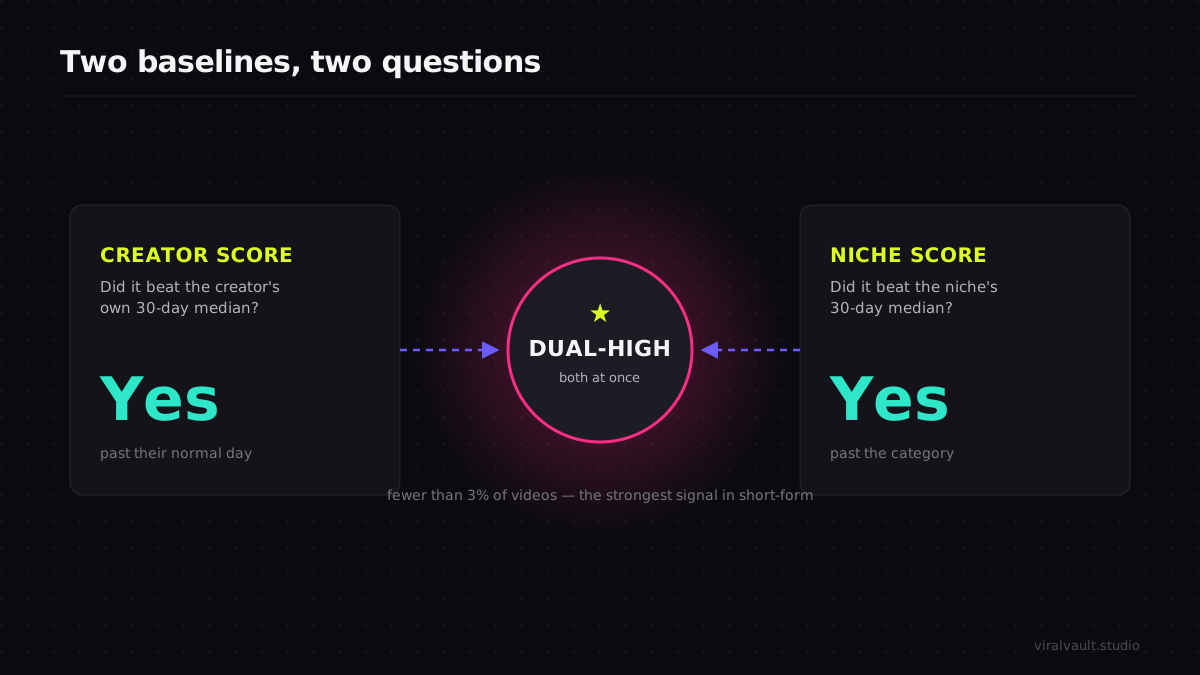
Here is the core idea the whole category turns on: one post deserves two scores, because there are two different "normals" it could be beating. ViralVault calls them the Creator Score and the Niche Score, and the difference between Creator Score vs Niche Score is the difference between a community story and a format story.
The Creator Score measures a video against that creator's own 30-day median views. A Creator Score of 500 means the post did five times what this account usually does — something about it broke the creator's personal ceiling. The Niche Score measures the same video against the niche's 30-day median. A Niche Score of 500 means the post did five times what an average video in that category gets — the algorithm is favoring this content over everything else in its lane.
Those two numbers answer two genuinely different questions. The Creator Score asks "did this beat the person who posted it?" The Niche Score asks "did this beat the category?" A video can ace one and flunk the other, and which one it aces tells you whether you are looking at a loyal audience that shows up for anyone, or a structure strong enough to travel to your account too. When both light up at once, ViralVault flags a Dual-High — the strongest virality signal in short-form video, and rare on purpose: 1,400+ videos in the index have cleared both.
For the full derivation — how the medians are computed, how cold-start creators and thin niches are handled, where the Dual-High thresholds sit — the companion breakdown on how the Outlier Score works walks through the math line by line. You can run both scores on any TikTok in your niche free at viralvault.studio.
Why one-number viral scores mislead you
A single outlier score collapses two questions into one, and the collapse is where it lies. "Five times normal" is meaningless until you say whose normal — and most tools quietly pick one baseline for you and hide the choice.
Anchor only to the creator and a mega-account problem appears. A huge channel posts a structurally forgettable video; because the account is enormous, even a routine post can read as a modest multiple of its own median, while a small creator's genuine breakout looks unremarkable next to it. You end up chasing formats that only worked because someone famous posted them — distribution, not structure.
Anchor only to the niche and the opposite distortion creeps in. A massive creator drops an ordinary video; against the category median it scores high purely because the account dwarfs the niche, and the score credits a format that had nothing to do with the result. Either single baseline answers a real question — but it cannot tell you whether you are buying a structure that travels or a ceiling effect you can never reproduce.
That is the entire case for dual-baseline scoring. One number forces a video into a single story; two numbers let it tell the true one. Platforms hint at the surrounding context — TikTok surfaces fragments of search and trend behavior, as TikTok's own newsroom has documented around Creator Search Insights — but a public feed shows you topics that are already broad, not whether a specific post beat both its creator and its category. Reading the two baselines together is what separates an outlier worth copying from one that only ever worked once.
ViralVault tip: When you read a score, always check which baseline is carrying it. A high Creator Score with a low Niche Score is community pull — great for that account, useless as a format. A high Niche Score is the one you can actually steal. See how the two scores are priced and unlocked.
How to use a dual-baseline outlier score in content research
Definitions only matter if they change what you do on a Monday morning. Used well, a dual-baseline outlier score turns "what should I make?" from a guess into a sort.
Start by ranking your niche, not your feed. Pull the videos in your category by outlier score so the over-performers float to the top instead of arriving in a random scroll. Then read both baselines before you get excited about any of them. Prioritize a high Niche Score, because a format that beat the whole category is one you can port to your own account; treat a high Creator Score on its own as a weaker buy, since it usually means a loyal audience rather than a repeatable structure. The videos worth your time are the ones where both numbers are high at once — the Dual-Highs — because neither audience size nor community loyalty alone explains them.
From there, save the structure, not the post. A score tells you a format mattered; your job is to capture why — the hook shape, the reveal, the pacing beat — and bank it as something you can rebuild in your own niche. One score is also a snapshot, so direction matters as much as magnitude: a rising score in an uncrowded niche has runway, while a sky-high score that has gone flat next to a dozen copies is a peak you are already late to. The deeper end-to-end routine for catching formats while they are still rising lives in the viral content discovery guide; the outlier score is the single measure that routine is built around.
The shift in mindset is the whole payoff. Most creators research by feel and make by panic — hours of scrolling, then a rushed guess. A dual-baseline outlier score replaces the feel with a number you can trust, so the scrolling becomes a sort and the guess becomes a shortlist of structures proven to travel.
Frequently Asked Questions
Q: What is an outlier score? A: An outlier score measures how far a single post over-performed relative to a baseline, reported as a multiple — a score of 500 means five times normal. It turns "this one hit different" into a number you can sort and compare across thousands of videos. ViralVault computes it against two baselines at once: the creator's own median and the niche median.
Q: What is dual-baseline scoring and why does it beat a single number? A: Dual-baseline scoring gives every post two outlier scores instead of one — a Creator Score against the creator's median and a Niche Score against the category median. A single number cannot separate a fluke on a huge account from a real format breakout on a small one. Two baselines keep those apart, so you copy structures that genuinely travel rather than distribution flukes.
Q: What is the difference between Creator Score vs Niche Score? A: Creator Score vs Niche Score answers two different questions. The Creator Score asks whether a video beat the person who posted it, measured against that account's 30-day median. The Niche Score asks whether it beat the whole category, measured against the niche median. A high Niche Score signals a portable format; a high Creator Score alone usually signals a loyal audience.
Make the viral score tool for social media posts your default
An outlier score is one idea worth holding onto: performance only means something against a baseline, and one baseline is never enough. Read a post against the creator and you learn whether it beat its own audience; read it against the niche and you learn whether the format can travel; read it against both and you finally know which it is. That is the whole job a viral score tool for social media posts does — it replaces a vanity number with a verdict you can act on. Stop guessing which videos are worth copying. Spin up a free account and run the Creator and Niche scores on the next post that catches your eye at viralvault.studio.