7 Signals That Predict a Video Will Go Viral Before It Does
By the time a video looks viral, the window to copy it has closed. Here are the 7 leading signals that fire before the peak — a scannable checklist for catching a format while it is still early.
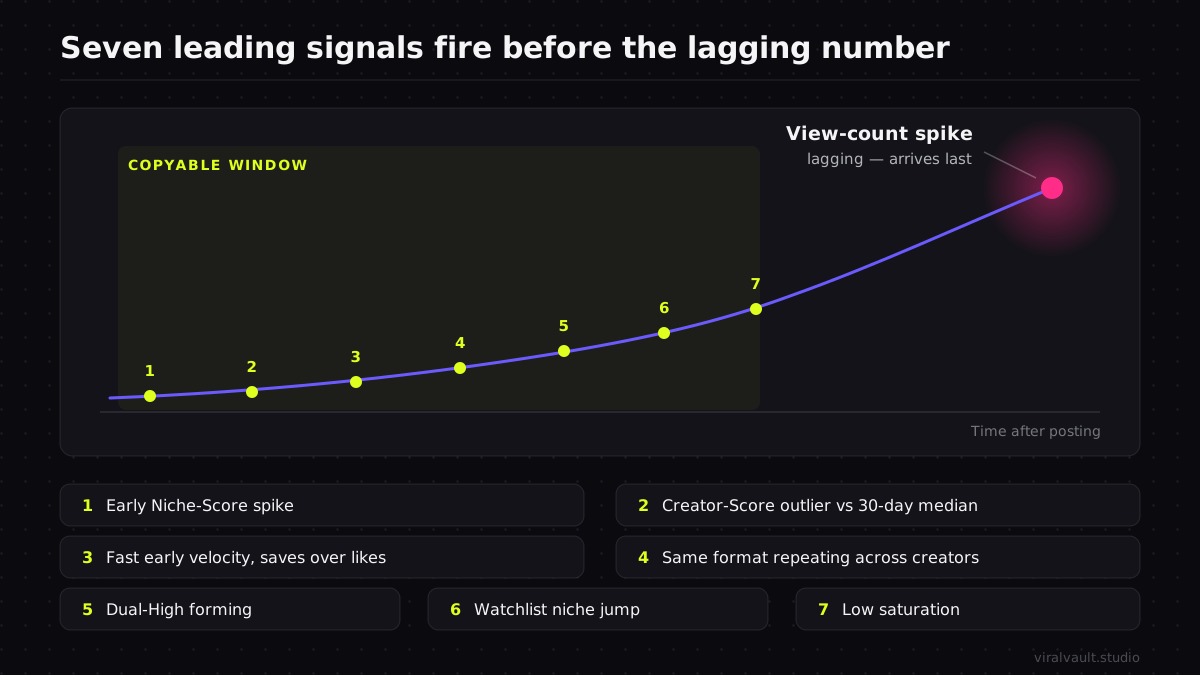
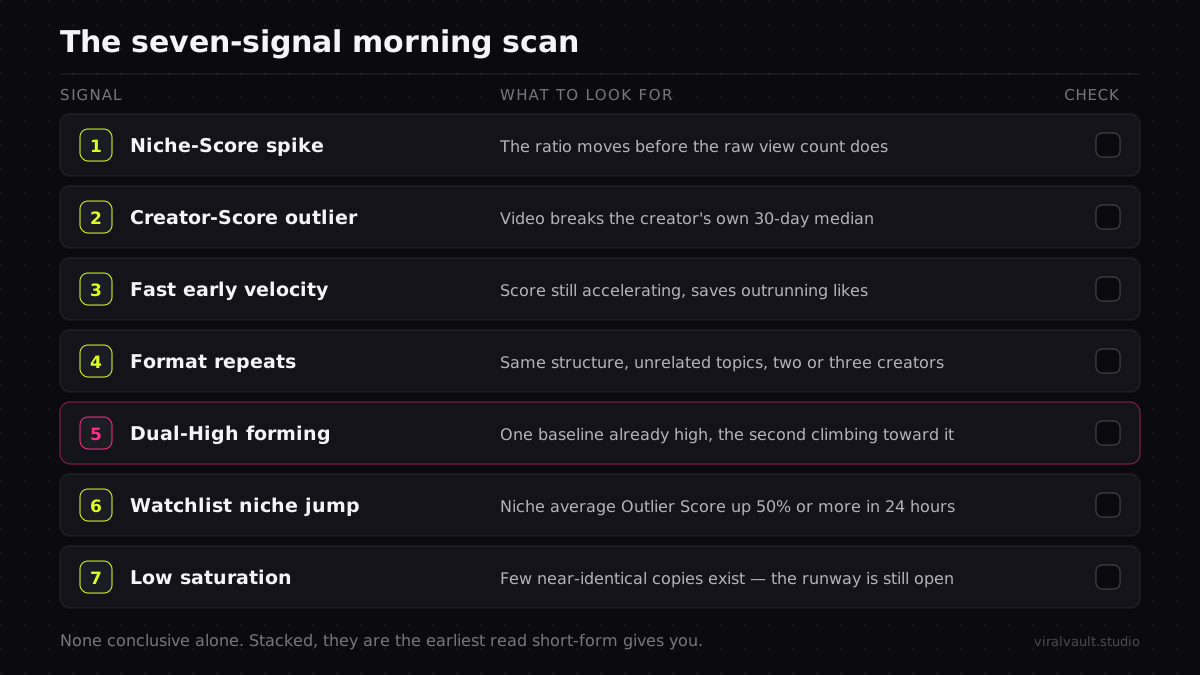
By the time a video looks viral, you are already too late to copy it. The view count that screams "breakout" is a trailing number — it confirms what happened days ago, long after the format started spreading and the feed began filling with copies. The creators who stay early are reading a different set of indicators entirely: leading signals that fire while a video is still climbing, before the peak, before the clones. Knowing how to find trending content before it peaks is not about spotting big numbers faster than everyone else. It is about reading the seven smaller tells that show up first. This is a checklist, not a theory — seven discrete signals you can scan against any TikTok in your niche, each one a piece of evidence that a format is rising rather than already spent. None of them is conclusive alone. Stacked, they are the closest thing short-form has to an early-warning system, and they are all visible before the number that makes everyone else notice.
Table of contents
- How to read a leading signal
- Signal 1 — an early Niche-Score spike
- Signal 2 — a Creator-Score outlier vs the 30-day median
- Signal 3 — fast early velocity
- Signal 4 — the same format repeating across creators
- Signal 5 — a Dual-High flag forming
- Signal 6 — a Watchlist niche jump
- Signal 7 — low saturation
- Reading the seven signals together
- Frequently Asked Questions
How to read a leading signal
A leading signal is one that appears before the outcome it predicts. A lagging signal — total views, the trending badge, the format showing up in your own feed — confirms the outcome after it has happened. Both are real data; only one is useful for timing. The entire skill here is learning to weight the leading indicators heavily and treat the lagging ones as confirmation you no longer need.
The reason this matters is the runway. A rising format is usually only worth making for a handful of days, sometimes three or four in a fast niche, because the algorithm pulls the peak forward and the first wave of copies tips it from rising into saturated. If you wait for the lagging signal, you spend your whole runway waiting. The seven signals below are ordered the way they tend to surface in a video's life — the earliest, faintest tells first, the louder confirmations last. Each gets its own section, what it looks like, and how to read it without overreacting to noise.
Signal 1 — an early Niche-Score spike
The first tell is the Niche Score moving before the absolute numbers look impressive. The Niche Score measures a video against the 30-day median for its category, so a video at 2x or 3x the niche median is already over-performing its lane even if its raw view count is modest. That gap — strong relative to the niche, unremarkable in absolute terms — is exactly what an early-stage breakout looks like. The crowd is watching the view count, which has not moved yet; you are watching the ratio, which has. Among the signs a video will go viral, an early Niche-Score spike is the one that most reliably arrives first, because the algorithm starts favoring a strong format inside its category before that favor compounds into a headline number. A video sitting at a Niche Score of 280 and climbing, with only a few thousand views so far, is a louder signal than a flat 700 that peaked last week.
Signal 2 — a Creator-Score outlier vs the 30-day median
The second signal is a video breaking its own creator's ceiling. The Creator Score compares a video to that creator's own 30-day median views, so a Creator Score of 500 means the video did five times what that account normally pulls. When a mid-size creator suddenly posts a video running far ahead of their personal baseline, something about that specific video broke through — and that something is usually the structure, not the account's growth. This is one of the clearest early viral indicators because a creator's own audience reacts before the broader feed does: the people who already follow them save and rewatch first, pushing the Creator Score up days before the niche at large catches on. Read it as a question, not a verdict — a Creator-Score outlier asks "what did this video do differently?" and the answer is the format you might copy. The mechanics of both baselines are broken down in how the Outlier Score works.
If you want to read both baselines on any TikTok in your niche, you can run the Outlier Score free with no card required at viralvault.studio.
Signal 3 — fast early velocity
The third signal is acceleration, not altitude. A video that gains a given number of views in its first few hours and keeps accelerating is behaving differently from one that posted a big number and went flat. Velocity — the rate of change of the score, not the score itself — is the cleanest read on whether a format is still rising. Watch the engagement split inside that velocity: when saves and shares outrun likes, viewers are bookmarking the video to copy or sending it to someone, both of which are intent signals that the format has legs beyond a single scroll. A like is a reaction; a save is a plan to use it. Fast early velocity with a save-heavy split is a format being treated as a template in real time, which is the strongest possible early read that copies are coming and the runway is open right now.
Signal 4 — the same format repeating across creators
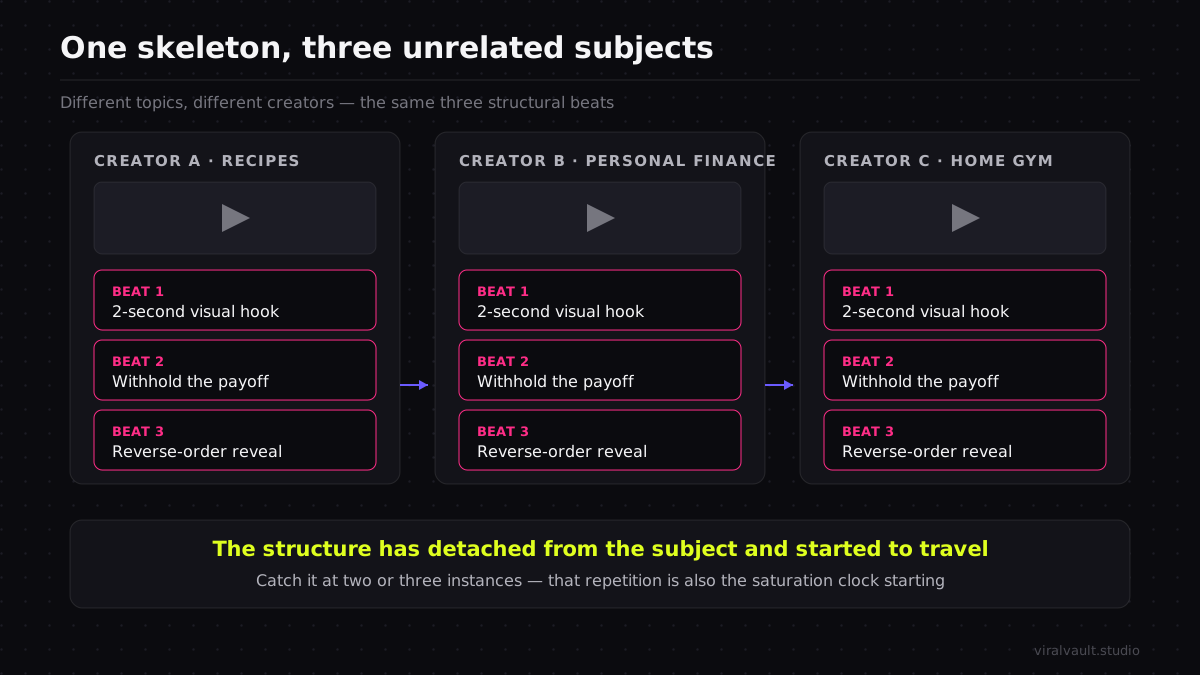
The fourth signal is a structure showing up on more than one account at once, while the topics stay different. When you see the same beat — a reverse-order reveal, a two-second visual hook, a specific way of withholding the payoff — carrying videos across unrelated subjects, that structure has detached from any single topic and started traveling on its own. That is the difference between a one-off hit and a portable format. Three creators in different corners of a niche independently landing the same structure within a few days is a far stronger signal than one video at ten times the views, because it proves the format works regardless of who posts it or what it is about. This signal is also your saturation clock starting: the same repetition that confirms a format is real is the leading edge of the copies that will eventually bury it, so catching it early — at two or three instances, not thirty — is the whole game.
Signal 5 — a Dual-High flag forming
The fifth signal is both baselines lighting up at the same time. When a video posts a high Creator Score and a high Niche Score together, ViralVault flags it as a Dual-High — the strongest virality signal in short-form video, because neither audience size nor community loyalty alone explains it. The format itself is winning. Dual-Highs are rare on purpose: 1,400+ videos in the whole index have cleared both. The leading-indicator version of this signal is a Dual-High forming — one baseline already high and the second climbing toward the threshold. Catching that convergence as it happens, rather than after both numbers have settled, is the difference between copying a format on day two and copying it on day six. A shortlist of forming Dual-Highs in your niche is a far better use of twenty minutes than scrolling the For You page hoping a pattern jumps out.
ViralVault tip: Sort your niche by Outlier Score and watch for videos where one baseline is high and the other is mid and climbing — those are Dual-Highs about to fire. The Today tab re-ranks across 12 niches daily, so a forming Dual-High surfaces while it is still early enough to copy, not after it has peaked. See how the scoring works.
Signal 6 — a Watchlist niche jump
The sixth signal is the niche moving, not just the video. Individual breakouts are noisy; a whole category lifting at once is a structural shift, and it almost always means a new format has entered the niche and started pulling everything up with it. Platforms hint at this kind of category-level movement in their own data — TikTok's own newsroom has documented how quickly search and trend behavior shifts around emerging topics — but the platform surfaces it broadly and late, after the move is already obvious. A Watchlist alert fires when a niche's average Outlier Score jumps 50% or more in 24 hours — the morning the surge starts, not the week it trends. That timing is the entire value: a niche-level jump is one of the earliest viral indicators available because it catches the format at the moment it begins spreading across creators, before any single video has accumulated the views that would make it obvious. When the alert lands, the right move is to open the niche immediately and find the structure driving the lift, because you are seeing the rise in progress rather than reading about it after the peak. Set the alert on the niches you actually post in and the system watches for this signal so you do not have to.
Signal 7 — low saturation
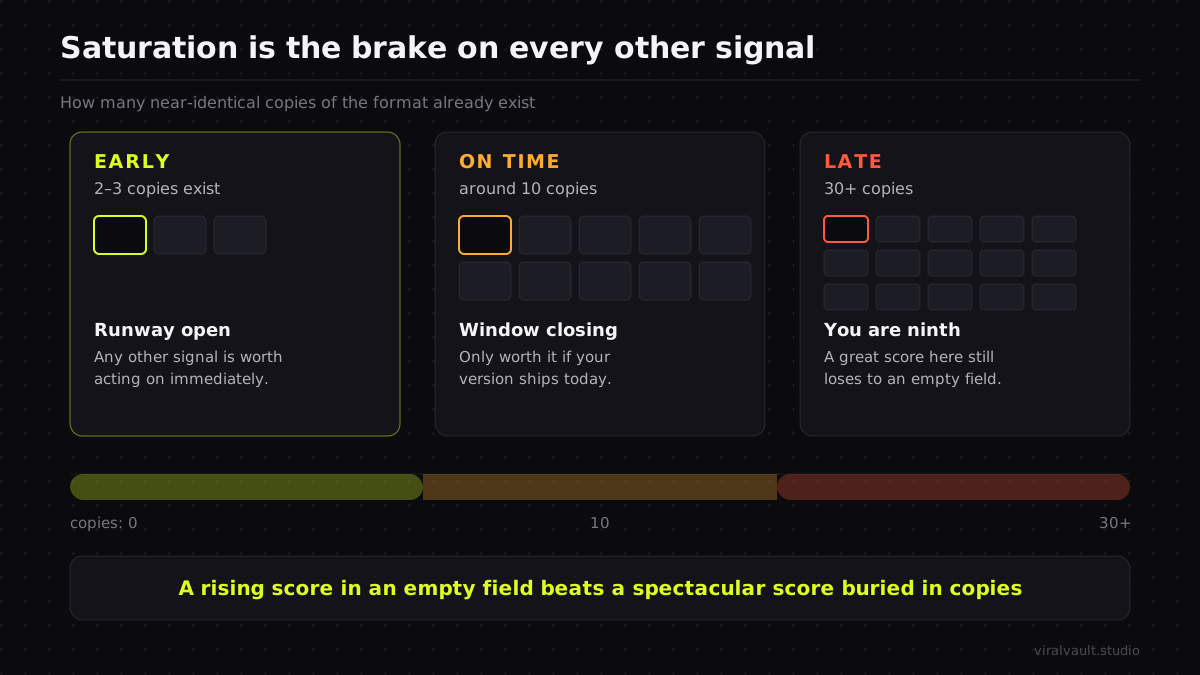
The seventh signal is the one that decides whether any of the others are still worth acting on: how many near-identical copies already exist. A rising score sitting in an empty field is wide open. The same rising score surrounded by a dozen lookalikes is a format you are already late to, no matter how good the number looks. Saturation is the brake on every other signal — it is why a merely good score climbing in an uncrowded niche will out-earn a spectacular score that has gone flat next to thirty copies. Estimate it by counting how many videos already run the same structure: at two or three, you are early; at ten, you are on time; past that, you are ninth. Low saturation paired with any of the six leading signals above is the cleanest possible buy, because you are purchasing runway, not a headline. This is also why most creators who try to copy a "viral" video flop — they arrive at full saturation, a failure mode broken down in why your TikTok content isn't going viral.
Reading the seven signals together
No single signal makes the call. The read comes from stacking them and asking whether they agree, the same way you would weight evidence rather than trust one witness. The strongest configuration is an early Niche-Score spike and a Creator-Score outlier, both accelerating on fast velocity, with the structure just starting to repeat across a couple of creators, a Dual-High forming, and saturation still low — that is a format caught at the exact moment it becomes copyable. The weakest is a high absolute number with flat velocity, the structure already everywhere, and saturation maxed: a video that was a signal last week and is a trap this week.
When the signals disagree, weight the leading ones — velocity, the forming Dual-High, low saturation — over the lagging headline number, because you are buying the runway, not the view count. A Niche Score of 300 that is climbing in an empty niche beats a 700 that has gone flat in a crowded one every time. The point of a checklist is that you stop relying on a single number you can misread and start reading a pattern that is hard to fake. Run these seven against your niche each morning and you will find trending content before it peaks as a matter of routine — the loud, late signal that makes everyone else notice becomes the one thing you no longer need.
Frequently Asked Questions
Q: What are the signs a video will go viral before it actually does? A: The earliest signs are relative, not absolute. An early Niche-Score spike, a Creator-Score outlier against the 30-day median, fast accelerating velocity with saves outrunning likes, the same structure repeating across creators, a forming Dual-High, a niche-wide Outlier Score jump, and low saturation all fire before the raw view count moves. Stack several and you are reading a real rise, not noise.
Q: How do I find trending content before it peaks instead of after? A: Stop watching view counts and start watching ratios and direction. Sort your niche by Outlier Score, confirm the score is climbing rather than flat, read both baselines, and check how many copies already exist. A rising score with low saturation is early; a high flat score surrounded by lookalikes already peaked. A Watchlist alert catches the niche-level move the morning it starts.
Q: Can you actually predict viral videos, or is it luck? A: You cannot guarantee a single video, but you can predict which formats are rising with real accuracy by reading leading indicators instead of trailing ones. Velocity, dual-baseline scoring, format repetition, and saturation are measurable and they move before the headline number does. It is closer to weather forecasting than to a coin flip — probabilities from signals, not certainty.
Q: What is the single strongest early viral indicator? A: A forming Dual-High — one baseline already high and the second climbing toward the threshold — paired with low saturation. Only 1,400+ videos in the whole index have ever cleared both, so catching one as it converges, before the copies arrive, is the strongest and earliest read you can get on a format worth copying.
Putting the seven signals to work to find trending content before it peaks
The takeaway is one line: read the leading signals, not the lagging number. A view count tells you a format already won; the seven signals above tell you it is winning, while you still have time to make your version. To find trending content before it peaks, you scan for the early Niche-Score spike, the Creator-Score outlier, the fast velocity, the structure repeating, the forming Dual-High, the niche-wide jump, and the open saturation field — and you weight the early tells over the loud one. Done daily, that scan turns guesswork into a system, because being early is a process, not a talent. Spin up a free account, set a Watchlist on your niche, and let these signals flag the next rising format before it peaks — start at viralvault.studio.