How to Use the TikTok Content Gap Tool to Go Viral in 2026

TikTok now points you at topics with heavy demand and almost no videos answering them. Here's the demand-to-ship workflow that turns those gaps into videos built to go viral in 2026.
Most creators still pick a topic, hope it lands, and blame the algorithm when it does not. In 2026 that guess is the most expensive mistake you can make, because TikTok now tells you which topics people are searching and which of those have almost no videos answering them. Knowing how to use TikTok content gap tool signals is the difference between shipping into a crowded feed and shipping into an open lane an audience is already waiting in. A content gap — heavy demand, thin supply — is the closest thing to a guaranteed audience a creator gets. But a gap is only half a viral video; the topic gets you found, the structure gets you watched. This playbook gives you a repeatable demand-to-ship workflow: read the gap, pick the format proven to over-perform on it, and ship the version built to go viral in 2026 instead of one more video that flops on a hunch.
Table of contents
- What the TikTok content gap tool is in 2026
- How to use TikTok content gap tool signals step by step
- Pairing the gap with an outlier score
- What going viral in 2026 actually requires
- Frequently Asked Questions
- Ship the gap before the feed fills
What the TikTok content gap tool is in 2026
The "content gap tool" is the content-gap signal inside TikTok Creator Search Insights — TikTok's in-app view of what people actually type into the search bar. Alongside popular searches, it flags the topics where interest is high but the supply of videos answering them is comparatively low. That flag is the whole game. A TikTok content gap is a query an audience is actively searching and almost nobody is satisfying, which means you are not fighting a thousand near-identical videos for the same viewer — you are often one of the few answers in the lane. For a fuller tour of the tool, where it lives, and how to read its niche filters, the TikTok Creator Search Insights guide covers the overview; this playbook is about turning that signal into shipped videos.
What makes 2026 different is that TikTok search has stopped being an afterthought. A growing share of users — younger ones especially — open the app to look something up the way an earlier generation opened a search engine, typing questions about products, recipes, places, and how-tos directly into TikTok. That behavior makes a content gap durable in a way a feed spike is not: a video that answers an under-served search keeps getting found every time someone types that query, long after the For You push fades. TikTok's own framing of this shift is documented through TikTok's newsroom, and the practical read is simple — the gaps you fill this year keep paying out next year.
There is one discipline that keeps this honest. The tool shows relative interest and relative content levels, not a precise monthly search volume you can paste into a spreadsheet. Treat every reading as directional: "this topic is clearly wanted and clearly under-served," never "this topic gets exactly N searches." Inventing a hard number where TikTok only gives you a relative signal is the fastest way to make a confident wrong decision.
The mental model that does the work is a simple four-box read. Every term you scan in the tool sorts by demand and supply, and only one box is the opening you act on first.
| Demand | Supply | What to do with it in 2026 |
|---|---|---|
| High | Low | The opening — make this first, you may be one of few answers |
| High | High | Real audience, crowded — needs a sharper format to break through |
| Low | Low | Niche or early — worth a test, not a tentpole |
| Low | High | Skip — hard competition for a small audience |
How to use TikTok content gap tool signals step by step
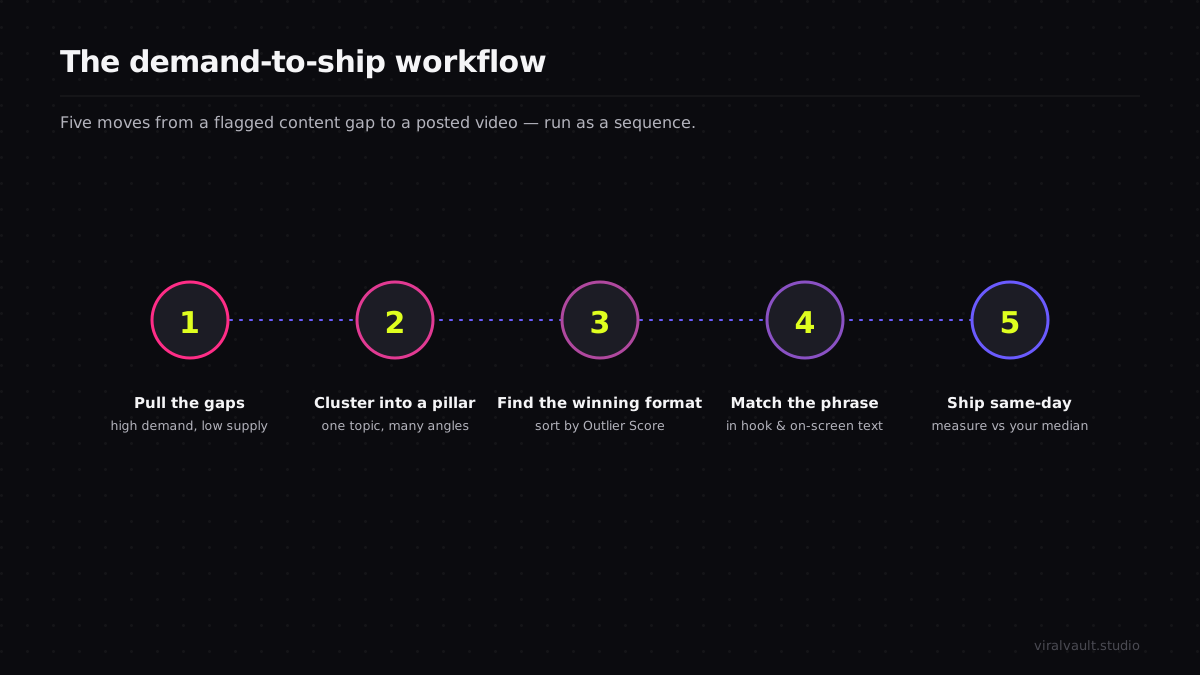
A list of wanted topics is not a content plan until you turn it into one. The workflow below takes a content gap from a flagged search to a posted video, and it is built so you act on the gap while it is still open rather than after the feed fills with copies. Run it as a sequence, not a brainstorm you cherry-pick from — that ordering is what separates creators who grow from search and creators who just browse the tool.
Before you script a single gap, run it through a format check — a free ViralVault search shows which structures are already over-performing on that exact topic, so you build on a proven shape instead of a blank page.
Step 1: Pull the gaps in your niche
Open Creator Search Insights, filter to your niche, and pull every content gap you can find — the high-demand, low-supply terms — into a running list at the top of a doc. The niche filter is what keeps the read honest: a term that looks small against the whole platform can be enormous inside a narrow lane, and the in-niche framing is what lets you tell the difference. Pull the gaps first and rank everything else below them, because a content gap is the highest-upside thing you can act on — TikTok's search and For You surfaces both reward content that satisfies a query nobody else is satisfying.
Step 2: Cluster the searches into one pillar
Ten related searches around the same theme are not ten videos — they are one pillar topic with nine supporting angles. A finance creator who sees separate gaps for a budgeting method, a specific app, and a beginner mistake should recognize them as one cluster about getting started with money. Making the pillar plus the satellites compounds: each video reinforces the others in search, and your account starts to read as the authority on that cluster rather than a scatter of one-offs. Clustering also future-proofs the work — a pillar built on a real content gap keeps surfacing satellites to make for weeks.
Step 3: Find the format proven to win the topic
This is the step that decides the outcome, and the one most creators skip. A topic tells you a subject is wanted; it says nothing about the shape of the video that wins it. Take the gap into ViralVault and sort that niche by Outlier Score to see which videos on the topic genuinely over-performed — not just which racked up views because a large account posted them. Study the winner three times with the sound off and map the skeleton: where the hook lands, what question it plants in the first two seconds, the order information is revealed, and where the payoff is withheld to drive completion. Write that down as a sequence of beats, not a description of the subject. The beats are the engine you copy; the topic is just the fuel.
Step 4: Match the search phrase to your hook and on-screen text
TikTok search reads the words you say and show, not only your caption. If the gap is a specific phrase, that phrase belongs in your first line of on-screen text and out of your mouth in the first few seconds — paired with the hook shape you reverse-engineered in Step 3. This is the heart of a content gap strategy: not keyword stuffing, but making the video unmistakably answer the exact question being asked, in the words it is being asked in, inside a structure proven to hold attention. The AI Hook Writer spins five variants — contrarian, listicle, POV, curiosity, and meme — so you can fit the phrase to the format fast instead of staring at a blank opener.
Step 5: Ship same-day, then measure against your median
Speed is the whole edge. A gap that is open on Monday can fill by Saturday in a fast niche, so make your version the day you find it, not the following week. After you post, ignore the raw view count and judge the video against your own 30-day median and the niche median. Clear either baseline by 2x or more and the format worked — keep the skeleton, refine the hook, and reshoot it on the next gap in your cluster. Miss both and the topic was fine but the structure broke somewhere; re-watch the original, find the flattened beat, and patch that specific one. That loop turns posting from a roll of the dice into a system that compounds.
Pairing the gap with an outlier score
The reason a content gap alone is not enough is that two creators can make a video on the identical searched topic, with the identical keywords in the title, and get opposite results. One opens flat and loses the viewer in two seconds; the other opens with a reverse-order reveal — the result first, then the steps — and holds them to the end. Same topic, same search phrase, opposite outcome. The difference is entirely structural, and none of it is visible in a demand tool. Worse, a plain view count will lie to you about which structures work: a video on your topic with two million views might have done that because the creator already had two million followers, while an eighty-thousand-view video on a small account could be the real lesson because something in its structure broke a ceiling it had no business breaking.
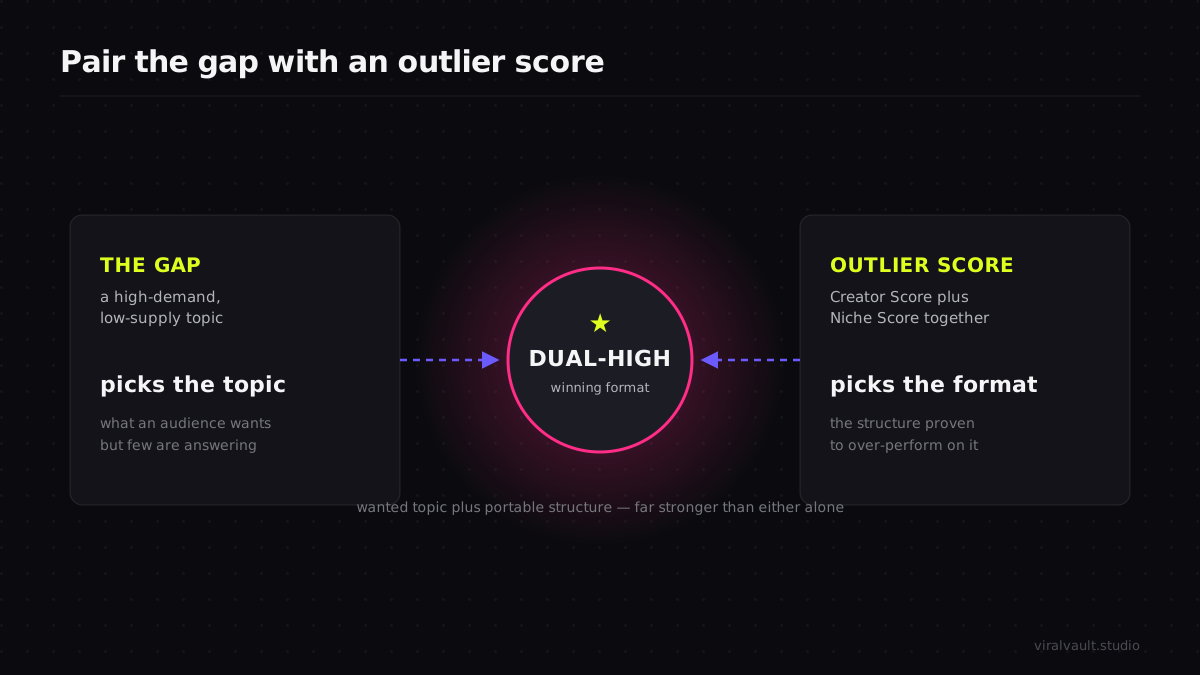
This is exactly the gap ViralVault was built to close. The ViralVault index tracks 23,000+ videos across 7,800+ creators and rescores them daily, scoring each video against two reference points at once: a Creator Score measuring it against that creator's own 30-day median, and a Niche Score measuring it against the niche's 30-day median. When both light up together, ViralVault flags a Dual-High — the strongest virality signal in short-form video, rare enough that only 1,400+ videos in the whole index have cleared both. The full mechanism, including how thin niches and cold-start creators are handled so the number stays fair, is broken down in how the Outlier Score works.
Reading those together changes what you copy. Instead of imitating the topic — which everyone reading the same search tool will also do — you imitate the structure proven to over-perform on it: the hook shape, the reveal order, the pacing of the payoff. Topics saturate; structures travel. A reverse-order reveal that pops on a finance gap works on a cooking gap too, because the tension it builds has nothing to do with the subject. Pair the wanted topic with the portable structure and the combination is far stronger than either alone.
ViralVault tip: When you find a content gap worth committing to, set a Watchlist on that niche. If its average Outlier Score jumps 50% or more in 24 hours, you get a niche-pop alert the morning the surge starts — so you catch a rising structure on an already-wanted topic while the lane is still open, not after the copies arrive. See how alerts work.
What going viral in 2026 actually requires
The honest version is that going viral in 2026 is less about a single lucky hit and more about running a tighter loop than the creators around you. The content gap tool removes the topic guess; the dual-baseline score removes the format guess. What is left is execution speed and a swipe file of proven structures, and both compound. Save every winning skeleton to a board, note the beat rather than the subject, and that board becomes a running shortlist of shapes ready to drop onto the next gap you find. The creators who consistently move numbers are rarely more creative than the ones who stall — they are reading demand and format instead of guessing at both.
The shortcut that keeps the loop fast is staying inside the surface where you found the demand. The Chrome extension overlays Outlier Scores directly on the videos you are already watching so you can validate a topic's best structure without leaving TikTok. The wider method for catching rising structures before they saturate lives in the viral content discovery guide, and it pairs cleanly with the gap workflow here: search tells you where the audience is, discovery tells you which shape reaches it. Run both for a few weeks and the two halves reinforce each other into a system that does not depend on a single video landing.

Frequently Asked Questions
Q: How do I use the TikTok content gap tool to find topics? A: Open Creator Search Insights, filter to your niche, and pull the high-demand, low-supply terms it flags — those are the content gaps. Cluster related searches into one pillar topic with supporting angles, then place the exact search phrase in your title, on-screen text, and spoken hook. Make the high-demand, low-supply topics first, because that is where a creator converts effort into reach most efficiently.
Q: What is a TikTok content gap? A: A TikTok content gap is a topic with heavy search demand but comparatively few videos answering it. TikTok Creator Search Insights flags these directly, and they are the highest-upside thing a creator can act on, because you are often one of the few answers in the lane instead of competing against a thousand near-identical videos for the same viewer.
Q: Does the content gap tool tell me how to structure the video? A: No. It is a demand map — it tells you a topic is wanted, not how to build the video that wins it. Two creators on the same searched topic get opposite results because the hook and structure decide the outcome. Pair the gap with a dual-baseline tool like ViralVault to see which formats genuinely over-perform on the topic, not just which got views.
Q: How do I turn a content gap into a video that goes viral in 2026? A: Pull the gap, cluster it into a pillar, find the structure proven to over-perform on that topic by sorting the niche by Outlier Score, match the search phrase to your hook and on-screen text, then ship same-day and measure against your 30-day median. Copy the winning skeleton, not the subject — structures travel across niches, topics saturate.
Q: Why does my video on a searched topic still flop? A: A wanted topic built in a weak structure still stalls, because TikTok decides satisfaction in the first few seconds through the hook and pacing, not the topic alone. A plain view count also misleads — a high-view video may have ridden a large follower base. Score the videos on your topic against a creator-and-niche baseline to find the structure that actually broke through.
Ship the gap before the feed fills
The lesson compresses to one move: read the demand, then read the format. Knowing how to use TikTok content gap tool signals gives you the first half for free — a map of exactly which topics your audience is searching and which almost nobody is answering — which already puts you ahead of every creator still picking topics from a hunch. But a wanted topic built in a weak structure still flops, so the second half matters just as much: pair each gap with the format proven to over-perform on it, read against a dual-baseline score so you copy structures that travel instead of view counts that mislead. Pull the under-served topic, find the winning shape, and ship the version built to get both found and watched — start free at viralvault.studio.