ViralLens Alternative: Why Dual-Baseline Scoring Wins

ViralLens is genuinely on the right track for creators. But the comparison turns on two things: how mature the dual-baseline scoring is, and how separately it keeps the two baselines — and in a thin, fast niche, both decide your read.
If you are shopping for a ViralLens alternative, you have already noticed the thing that makes this comparison interesting: ViralLens and ViralVault are not built on opposite philosophies the way a PR tool and a creator tool are. Both are aiming at the same job — short-form viral content discovery, scored against a baseline rather than ranked by raw views. ViralLens is an emerging tool moving in exactly the right direction for creators, and that deserves to be said plainly. So this is not a "different lanes" comparison; it is a head-to-head on maturity. Two things decide it: how developed the dual-baseline scoring actually is, and how genuinely separate the two baselines are kept underneath it. Both matter most in the hardest case — a thin niche that moves fast, where a half-built score quietly hands you the wrong read. This guide lays out what ViralLens is built for, a side-by-side table, the two differences that settle it, and a clear verdict so your trial time is not spent guessing.
Table of contents
- What ViralLens is built for
- Why ViralVault is the ViralLens alternative for serious discovery
- ViralLens vs ViralVault side by side
- Why dual-baseline maturity decides the comparison
- Why a separate creator baseline matters most in a thin or fast niche
- The verdict
- Frequently Asked Questions
What ViralLens is built for
ViralLens belongs to a small and welcome category: tools that treat short-form discovery as a measurement problem, not a popularity contest. The premise it shares with ViralVault is the right one — a video should be judged against a baseline, so a genuine breakout stands out instead of being buried under whatever the biggest account posted that day. That instinct is the hard part of this space to get right, and ViralLens is reaching for it rather than reselling a generic trend feed. For a creator who has outgrown raw view counts and wants something that understands over-performance, it is a reasonable place to look.
Where ViralLens sits today is earlier in its development: its dual-baseline methodology is less developed than the established leaders. That is not a knock on the direction — it is a statement about stage. A scoring model still maturing has fewer of the guardrails that stop a single freak hit or a sparse niche from skewing the number. For a creator in a large, slow, well-documented niche, that gap may rarely bite. The question this comparison answers is what happens when the niche is neither large nor slow.
Being fair about a competitor means naming the strength first and the limits in context. ViralLens is on the right track for creators, and a head-to-head should make its case on specifics rather than vague dismissal. The specifics here are maturity of the score and how separately the two baselines are kept — and those are exactly the two axes where a more established tool pulls ahead, which is the rest of this article.
Why ViralVault is the ViralLens alternative for serious discovery
ViralVault is the ViralLens alternative built for creators who need the read to hold up under pressure — a niche with few videos, a window that closes in days, a small account whose breakout is easy to miss. It is TikTok-native, it tracks 23,000+ videos across 7,800+ creators, and every one of those videos carries two separately computed scores rather than one blended number. TikTok itself signals how fast search and trend behavior shifts on the platform, documented through its own newsroom, which is exactly why what a score is measured against is not a cosmetic detail — it is the whole of whether the score is honest.
The scoring is the part that has been pushed furthest. The Outlier Score is a dual-number measure: a Creator Score that compares a video to that creator's own 30-day median, and a Niche Score that compares it to the niche median. The thresholds are published rather than vibes: a Dual-High is a Creator Score of 500 or more — five times that creator's own median — and a Niche Score of 300 or more, three times the niche median, at the same time. 1,400+ videos in the index have cleared both. That is not a single ratio with a label slapped on it; it is two independent baselines that have to agree, which is the difference between "this looks big" and "this broke a ceiling it had no business breaking." The full mechanism is broken down in how the Outlier Score works.
Around that core sit the tools that turn a read into a post. The Today tab surfaces what is hitting across 12 niches, each with its own median to score against. The AI Hook Writer spins five hook variants — contrarian, listicle, POV, curiosity, meme — from any winning video on GPT-4o mini. Boards save formats and export a PNG score card for a brief, Watchlist alerts fire when a niche's average Outlier Score jumps 50% or more in 24 hours, and the Chrome extension overlays scores on videos you are already watching with hooks. Score any TikTok in your niche free, with no card required, at viralvault.studio.
ViralLens vs ViralVault side by side
Read this table as a maturity map, not a takedown. The ViralLens vs ViralVault question is about how far each has developed the same shared idea, so the rows that matter most are the ones about how the score is built and what it is measured against.
| Dimension | ViralVault | ViralLens |
|---|---|---|
| Core approach | Dual-baseline outlier scoring for short-form | Emerging dual-baseline discovery |
| Scoring model | Creator Score + Niche Score, both vs median | Dual-baseline, less developed |
| Strongest signal | Dual-High — Creator ≥ 500 and Niche ≥ 300, both published thresholds | Single combined read |
| Niche coverage | 12 niches, each with its own scoring baseline | Developing |
| Hook generation | AI Hook Writer, 5 variants (GPT-4o mini) | Not a focus |
| Browser overlay | Chrome extension, | Not a focus |
| Best fit | Thin or fast niches needing a reliable read | Early-stage, broad-niche exploration |
The honest way to read this is by your own niche. A creator in a broad, slow-moving niche with plenty of videos may find an emerging tool's single blended read perfectly serviceable, because the law of large numbers is doing the work for them. A creator in a thin or fast niche is relying on the tool itself to supply what the niche cannot — a second baseline that does not depend on how busy the category is. For the wider field of options beyond these two, the roundup of the best viral content discovery tools for 2026 maps where each one sits.
Why dual-baseline maturity decides the comparison
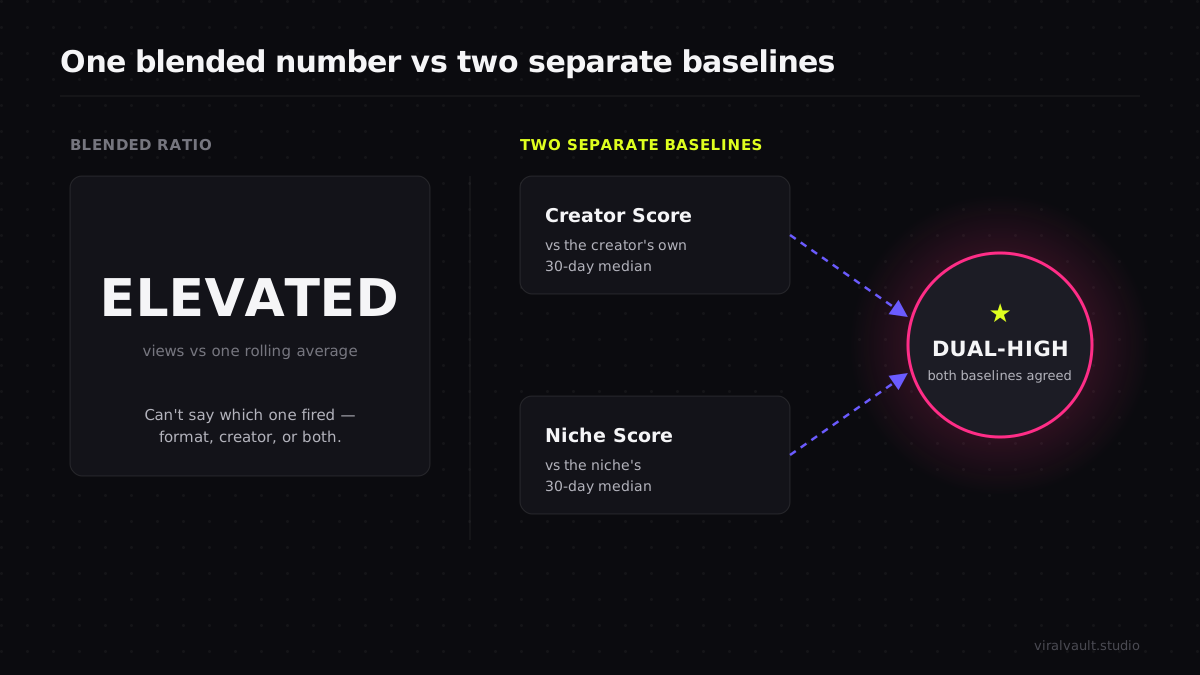
The phrase "dual-baseline scoring" can describe two very different things, and the gap between them is the whole comparison. The shallow version computes one blended ratio — views against some rolling average — and presents it as a single outlier number. The mature version keeps the two baselines genuinely separate: a creator baseline and a niche baseline, each measured against a median over a rolling window, each able to disagree with the other. That separation is what makes the score readable instead of merely high.
Here is why the difference bites. A video can be a Creator-High and a Niche-Low at the same time — a personal best for a small account that is still ordinary by niche standards. It can also be Niche-High and Creator-Low — a format spiking everywhere that this particular creator happened to ride without breaking their own ceiling. A single blended number cannot tell those two situations apart; it just reports "elevated." A mature dual-baseline score reports which baseline lit up, and that tells you what to actually copy: the format, the creator's execution, or both. When both fire together, that is the Dual-High, and the reason it is the strongest signal is precisely that two independent measures agreed.
Maturity also shows up in the guardrails. Using the median rather than the mean stops one freak hit from poisoning a baseline. A long enough rolling window stops last week's anomaly from masquerading as a trend. Those are the unglamorous details that separate a score you can trust from one that looks impressive in a demo and misleads you on a Tuesday. An emerging tool is still building those guardrails; that is what "less developed methodology" means in practice, and it is the first of the two reasons a more established ViralLens alternative gives you a steadier read.
ViralVault tip: When you trial any discovery tool, run a video you already understand through its score — one you know was a small-account format breakout. A mature dual-baseline model will separate the creator pull from the format strength and tell you which one carried it. Score one free and watch it split the two.
Why a separate creator baseline matters most in a thin or fast niche
The second decider is what each score is compared against, and its importance scales inversely with how big and slow your niche is. In a broad, busy niche, the niche median alone is a reasonable yardstick — there is enough recent video around it that "above average for this category" means something. The trouble starts at the edges: the niche that is small, new, or moving too fast for a category median to describe.
A thin niche is the obvious case. When your corner of short-form is quiet, the niche median is computed from few videos, and a single big post can drag it up or down. Lean on that one number and you get false breakouts and missed ones in equal measure. This is exactly where the second baseline earns its place: the Creator Score never touches the niche median at all. It asks only whether this video beat this creator's own 30-day median, which is a question a thin niche cannot corrupt. You still get a trustworthy read on a small account in a quiet niche, because one of the two numbers is immune to how quiet it is.
A fast niche is the subtler case. When formats turn over in days, the category median you are scoring against is describing a niche that has already moved on. Reading the two baselines separately is what saves you: a Niche Score that is climbing while creator baselines stay flat is a format spreading through the category right now, and that divergence is visible as it happens rather than after both numbers have settled. A single blended figure averages that signal away. For the end-to-end routine of finding a rising format and shipping before the window closes, the viral content discovery guide walks the loop.
The verdict
The decision comes down to one question: how forgiving is your niche? If you work in a broad, slow-moving niche with a deep well of videos, an emerging tool like ViralLens may serve you well — the niche itself supplies the sample size and the stability, and a single blended, still-maturing score has room to be approximate without misleading you. ViralLens is on the right track, and for that situation it is a fair choice, not a compromise.
If you work in a thin niche, a fast niche, or you are trying to catch a small-account breakout before anyone else does, the more developed tool is the safer call, and ViralVault is the clearer ViralLens alternative. A mature dual-baseline score that keeps the creator and niche baselines genuinely separate tells you which one fired, and it keeps working when the niche is too quiet for a category median to mean much — because the Creator Score never depends on the niche at all. That is exactly what a younger tool is still building, and exactly what the hard cases demand.
What makes this an easy call at the edges and a close one in the middle is that both tools want the same thing — they are just at different stages of getting there. Decide where your niche falls on the forgiving-to-brutal scale, and the right pick follows. For most creators chasing early formats in tight niches, the separation and the maturity of the score are what tip it.
Frequently Asked Questions
Q: What is the best ViralLens alternative for creators? A: For creators in thin or fast-moving niches, ViralVault is the closest and more developed ViralLens alternative. It uses a mature dual-baseline Outlier Score that keeps the creator and niche baselines separate, with published thresholds — Creator 500, Niche 300 — so you can see exactly what a Dual-High means. ViralLens is a fair emerging option for broad, slow niches where a single blended read is enough.
Q: How is ViralVault different from ViralLens? A: Both score short-form video against a baseline, but ViralVault's dual-baseline scoring is more developed. ViralVault separates the Creator Score and Niche Score so you can see which one fired, and publishes the exact Dual-High cut-offs (Creator 500, Niche 300) rather than presenting one unexplained number. ViralLens is an emerging tool with a less developed methodology.
Q: Is dual-baseline scoring better than a single outlier number? A: For reading what to copy, yes. A single blended number only says a video is elevated. Dual-baseline scoring measures a video against the creator median and the niche median separately, so it tells you whether the format, the creator's execution, or both drove the result. When both baselines fire together, that Dual-High is the strongest virality signal in short-form.
Q: Does a second baseline matter for viral content discovery? A: It matters most in thin or fast niches. When a category is quiet, the niche median is computed from few videos, so leaning on it alone produces false reads. A separate Creator Score — this video against this creator's own 30-day median — is unaffected by how busy the niche is, so you still get a trustworthy read on a small account in a quiet corner.
Q: Is ViralLens a good tool? A: ViralLens is an emerging viral content discovery tool moving in the right direction for creators, and that is a genuine strength. Its dual-baseline methodology is less developed than the established leaders, so it fits broad, slow niches better than thin, fast ones. The right choice depends on how forgiving your niche is.
Choosing the right tool for your niche
The takeaway fits in a sentence: pick the tool whose maturity matches how hard your niche is to read. ViralLens is a fair, emerging choice for a broad and slow niche where the sample size carries you; the stronger ViralLens alternative for a thin or fast niche is the one that keeps the creator and niche baselines genuinely separate, because that is the thing a forgiving niche hides and a brutal one exposes. Decide where your niche sits, and the comparison stops being close. For creators chasing early formats in tight windows, separation and maturity win — start free, set a Watchlist on your niche, and run your next idea through the Outlier Score at viralvault.studio.