ViralVault vs. BuzzSumo: Short-Form Data vs PR Research

Both tools are strong — at different jobs. BuzzSumo owns web-article and PR research; ViralVault owns TikTok short-form discovery. Here's how to pick the right one fast.
The honest answer to "which is better" is that these two tools are not competing for the same job, so the right pick depends entirely on what you make — and if you make TikTok, you are really shopping for the best BuzzSumo alternative for content creators rather than a like-for-like swap. BuzzSumo is a content analytics and PR platform built for enterprise marketing and communications teams who research web articles, track shares and backlinks, and monitor journalists and brands. ViralVault is a TikTok-native creator tool built to score short-form video, surface rising formats, and write hooks. If your work lives in press coverage, blog content, and link analysis, BuzzSumo is the stronger buy. If your work lives in vertical video and the For You page, ViralVault is the gap-filler. This guide lays out what each tool is genuinely good at, a side-by-side feature table, the two differences that decide it, how pricing compares, and a clear verdict so you do not waste a trial figuring it out.
Table of contents
- What BuzzSumo is built for
- Why ViralVault is the BuzzSumo alternative for content creators
- Side-by-side comparison
- Difference 1: dual-baseline scoring vs flat share counts
- Difference 2: TikTok-native hooks vs web and PR research
- Pricing compared
- The verdict
- Frequently Asked Questions
What BuzzSumo is built for
BuzzSumo is a mature content analytics and media-monitoring platform, and it earns its reputation in the lane it was designed for. Its core job is web-content research: type a topic or a domain and it returns the articles that earned the most engagement across social and the web, ranked so a marketing team can see which angles and headlines travel. For content marketers planning blog calendars, brief writers hunting proven angles, and SEO teams sizing up what already ranks and gets shared, that is genuinely useful work done well.
The platform's other half is public relations and media monitoring. BuzzSumo helps PR and communications teams find the journalists and outlets covering a subject, track brand and competitor mentions as they happen, and watch backlink and share activity around a story. For an enterprise comms team running outreach, managing reputation, or reporting on earned media, this is the kind of tooling that justifies a seat — it consolidates research that would otherwise span half a dozen tabs.
That focus is a strength, not a weakness, and any fair comparison has to say so plainly. BuzzSumo is built for marketing and PR organizations working in articles, domains, and journalist relationships. The limitations only appear when you point it at a job it was never scoped to do — namely, discovering and reverse-engineering short-form TikTok video, which is a different medium with different signals entirely. Naming those creator-specific gaps is fair; calling the tool weak in general would not be.

Why ViralVault is the BuzzSumo alternative for content creators
ViralVault starts from the opposite end of the content world. It is a TikTok-native tool for creators, built around the one question short-form makers actually ask: which video formats are over-performing in my niche right now, and how do I make my own version before the format saturates? TikTok itself signals how central this kind of search behavior has become, documenting features like Creator Search Insights through its own newsroom. The ViralVault index tracks 23,000+ videos across 7,800+ creators, every one of them scored against both its own creator's baseline and its niche's baseline, so the data underneath is short-form video, not web pages.
The headline feature is the dual-baseline Outlier Score. Every video is measured against two reference points at once — how that creator normally performs and how the niche normally performs — so a breakout on a small account is not buried under the raw numbers of a mega-account having an ordinary day. Format Discovery surfaces the structures spiking across 12 niches in the Today tab, and when both baselines light up together, ViralVault flags a Dual-High — 1,400+ videos in the index have cleared both baselines at once. The full method is broken down in how the Outlier Score works.
Around that core sit the tools a creator uses to act on what they find. The AI Hook Writer, running on GPT-4o mini, spins hook variants matched to a winning format. Boards save structures and export a PNG score card to drop into a brief at /b/[slug]. Watchlist alerts fire when a niche's average Outlier Score jumps 50% or more in 24 hours, and the Chrome extension overlays scores on videos you are already watching. None of that is web-article analytics — it is short-form production tooling.
Score any TikTok in your niche free, with no card required, at viralvault.studio.
Side-by-side comparison
The fairest way to read this table is as a map of two specializations, not a scoreboard. Each tool wins the rows that match its medium.
| Feature | ViralVault | BuzzSumo |
|---|---|---|
| Built primarily for | TikTok creators, UGC makers, organic brands | Enterprise marketing and PR teams |
| Core content type | Short-form vertical video | Web articles, blog posts, domains |
| Discovery model | Dual-baseline Outlier Score (creator + niche) | Engagement, share, and backlink rankings |
| Short-form TikTok video research | Yes, native | Not a focus |
| Dual-baseline outlier scoring | Yes | No |
| AI hook generation for video | Yes (GPT-4o mini) | No |
| Journalist and brand monitoring | No | Yes, a core strength |
| Backlink and share analysis | No | Yes, a core strength |
| Niche format tracking | 12 niches, each with its own scoring baseline | Topic and domain trends |
| Browser overlay for creators | Chrome extension | Not applicable |
| Free tier | 3 searches/day, no card | Trial-based, enterprise/team pricing |
| Best fit | Make short-form, find rising formats | Research web content, run PR and outreach |
Read the table by your own use case rather than by row count. A PR manager will find ViralVault has none of the journalist-monitoring or backlink tooling their job requires. A TikTok creator will find BuzzSumo has no short-form video discovery, no dual-baseline score, and no hook generation. Neither result is a flaw — it is each tool staying inside its scope. For a wider field of short-form options, the roundup of the best viral content discovery tools for 2026 maps where ViralVault sits among creator-first tools.
Difference 1: dual-baseline scoring vs flat share counts
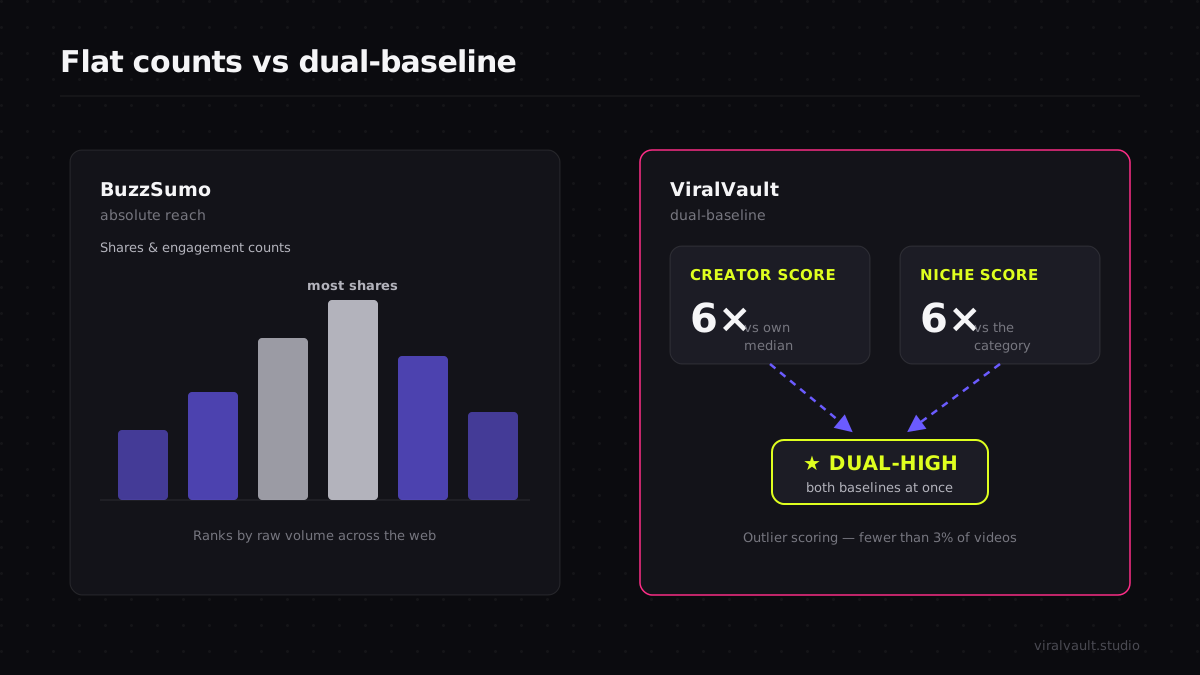
The first decisive difference is how each tool decides what counts as a winner. BuzzSumo ranks content largely by absolute engagement — total shares, backlinks, and reactions across the web. For its audience that is the correct measure: a PR team genuinely wants the articles with the most reach, full stop, because reach is the outcome they are paid to produce. Absolute numbers answer their question well.
For a creator, absolute numbers hide the one thing that matters. A TikTok with two million views from an account with two million followers is an average day; the same two million views from a creator with eighty thousand followers is a format breakout — something in the structure of that video broke a ceiling it had no business breaking. Rank by raw views or shares and the first video sits on top while the second, the one you could actually learn from, disappears down the list.
Dual-baseline scoring exists to fix exactly that. ViralVault's Outlier Score measures every video against the creator's own median and the niche median at the same time, so a structurally strong video on a small account rises to the top where you can copy it. Both baselines use the median over a rolling window so a single freak hit never distorts the reference. That is a short-form-specific design decision with no equivalent in a web-content tool, because web-article research is not trying to separate format strength from account size — it is measuring reach directly. The same creator-versus-niche logic is what separates ViralVault from TikTok spy tools too, covered in the SpyTok comparison.
ViralVault tip: When you compare tools, test them on the exact job you do daily. Run a TikTok from your niche through the Outlier Score and watch it separate creator pull from format strength — something a share-count ranking cannot show you. See how the free tier works.
Difference 2: TikTok-native hooks vs web and PR research
The second decisive difference is what each tool helps you do after you have found something. BuzzSumo's output flows into a research-and-monitoring workflow: you take the high-performing articles, the journalist contacts, and the share data and feed them into content briefs, outreach lists, and reputation reports. For a marketing or PR team that is the whole point, and the platform supports that hand-off well — research in, strategy and outreach out.
ViralVault's output flows into a production workflow instead, because a creator's next step is not a press list, it is shipping a video today. Once Format Discovery surfaces a rising structure, the AI Hook Writer generates hook variants matched to that format on GPT-4o mini, Boards capture the structural beat and export a score card for a brief, and the Chrome extension keeps the loop inside the TikTok tab you are already in. The job is not researching the web; it is reverse-engineering a short-form format and making your version before the window closes.
This is the cleanest line between the two products. One is built to research web content and manage media relationships; the other is built to discover short-form formats and turn them into video. A PR team handed the hook writer would have little use for it, and a TikTok creator handed a backlink report would have little use for that. The step-by-step routine for the creator side lives in the viral content discovery guide, which walks the find-it-then-ship-it loop end to end.

Pricing compared
Pricing reflects the two audiences as much as the feature sets do. BuzzSumo is priced for marketing and PR organizations — a team-and-enterprise model with tiers scaled to seats, monitoring volume, and the breadth of its content-analytics and media-monitoring features. That structure fits a department buying a shared research and PR platform, where the spend is allocated across a team and measured against earned-media outcomes. Because published plans change, treat the specifics as enterprise or team-priced and confirm current numbers directly before budgeting.
ViralVault is priced for individuals. The free tier gives 3 searches a day with no card required, which is enough to score videos in your niche, read both baselines, and save a handful of formats to a board. Pro is $19 a month and adds Watchlist alerts, the AI Hook Writer, and the Chrome extension. That is a single-creator price point built around a daily research-and-post habit, not a team license.
The mismatch in models is itself a signal about fit. A solo creator or a small UGC studio is unlikely to want an enterprise PR platform's pricing or its surface area, and a large marketing department is unlikely to standardize on a single-creator video tool. Match the price model to how you actually work: a per-seat enterprise research suite for a comms team, or a low monthly creator subscription for someone shipping short-form.
The verdict
The decision comes down to one question: what medium do you work in? If you are a PR, communications, or B2B-content team — researching web articles, tracking shares and backlinks, monitoring journalists and brand mentions, and reporting on earned media — BuzzSumo is the stronger tool, and nothing here suggests otherwise. It was built for that work, it does it well, and a creator-first tool would leave you missing the monitoring and link-analysis features your job depends on.
If you are a TikTok creator, a UGC maker, or an organic brand whose growth lives on the For You page, ViralVault is the better fit and the clearest BuzzSumo alternative for content creators. The dual-baseline Outlier Score, Format Discovery across 12 niches, the AI Hook Writer, Boards, Watchlist alerts, and the Chrome extension are all short-form-native — exactly the tooling a video-first workflow needs and exactly what a web-and-PR platform was never scoped to provide.
The reason this is not a close call in either direction is that the tools barely overlap. Picking between them is less "which is better" and more "which medium is mine." Answer that and the choice makes itself.

Frequently Asked Questions
Q: Is ViralVault a good BuzzSumo alternative for content creators? A: For TikTok and short-form creators, yes. ViralVault is built around short-form video — dual-baseline Outlier Scores, Format Discovery across 12 niches, and an AI hook writer — which BuzzSumo does not offer. BuzzSumo remains the stronger pick for web-article research and PR work, so the right answer depends on whether you make video or research web content.
Q: Does BuzzSumo work for TikTok creators? A: BuzzSumo is a web-content and PR platform, so it does not provide short-form TikTok video discovery, outlier scoring, or hook generation. A TikTok creator would find its core strengths — share and backlink analysis, journalist monitoring — aimed at a different job. For TikTok-native format discovery, a creator-first tool like ViralVault fits the workflow far better.
Q: What does ViralVault do that BuzzSumo does not? A: ViralVault scores short-form video against two baselines at once — the creator's median and the niche median — to separate a small-account format breakout from a big-account average day. It also writes TikTok hooks with GPT-4o mini and overlays scores in-browser. BuzzSumo ranks web content by absolute engagement and shares, which is a different measure for a different medium.
Q: How much does ViralVault cost compared to BuzzSumo? A: ViralVault has a free tier with 3 searches a day and a Pro plan at $19 a month, priced for individual creators. BuzzSumo uses an enterprise and team pricing model scaled to seats and monitoring volume, suited to marketing and PR departments. Confirm BuzzSumo's current numbers directly, since published plans change over time.
Q: Which should I choose, ViralVault or BuzzSumo? A: Match the tool to your medium. Choose BuzzSumo if you are a PR, communications, or B2B-content team working in web articles, backlinks, and media monitoring. Choose ViralVault if you are a TikTok creator, UGC maker, or organic brand who needs short-form format discovery and hook generation. The two tools rarely overlap, so your work decides it.
Choosing the right tool for your medium
The takeaway fits in a sentence: pick BuzzSumo for web-content and PR research, and pick ViralVault for short-form TikTok discovery. Both are strong inside their lane, and the comparison only feels close if you ignore which medium you actually work in. A PR team and a TikTok creator have genuinely different problems, and each tool solves one of them well. For makers whose growth depends on the For You page, the best BuzzSumo alternative for content creators is the one built for short-form from the ground up — start free, set a Watchlist on your niche, and run your next idea through the Outlier Score at viralvault.studio.